|
|
This week we said goodbye to many of the students and volunteers who are traveling for the holiday season. Maria Wang left behind her dicanthelium to travel to visit with family in the UK. One of our volunteers, Bill W., is preparing for a trip to Panama. While a few people will be coming in next week, we won’t see most of our volunteers until next year. We’ve made a lot of progress in the past few months. Here is a brief summary of what we’ve accomplished since September:
1. New faces
We hosted several new interns this fall. Five students from Lakeforest College completed a four week internship on various projects (you can read about some of their work on the flog) . Marie (Carleton College) has been doing great work for an ongoing study on flowering phenology in prairie remnants. We will miss her when she goes back to school.
2. Lots and lots of counting
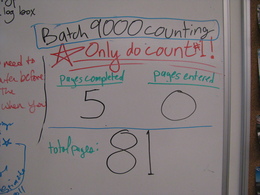
We have made a big dent in counting the achenes harvested in 2011 from the main experimental plot. We finished all counting for the 1999 experiment (4000s batch) and have begun counting for the rest of the 2011 harvest. And of course, no counting endeavor would be complete without a motivational whiteboard graphic.

3. New protocols
Because there are relatively few Echinacea heads to process from this year, we have an opportunity to try out different protocols and improve our methods. Our new protocol for selecting a random sample of seeds will improve our ability to assess pollination based on seed weight. We are also trying out new techniques for extracting seed heads and separating the dust.
That about sums it up. These details (protocols, cleaning, etc.) may seem minor, but they are important for creating reliable data.
Hi everyone,
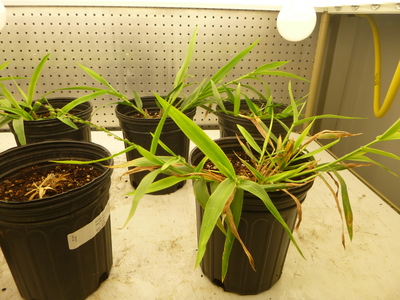
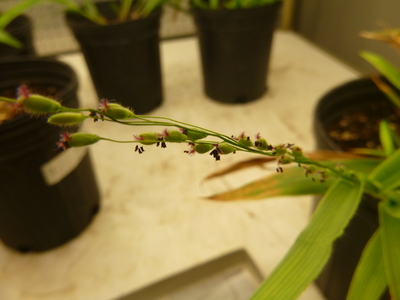
Maria here at CBG. On Tuesday, I came back from Thanksgiving break to find that one of the Dichanthelium plants in the growth chamber was flowering like crazy!

So many flowers! It was also interesting that the plant that flowered looked more stressed (yellow leaves) than some of the other plants.
Today, I collected some pollen (shook the spikelets) on glass slides, stained them with 0.1% toluidine blue, and looked at them under the microscope. It was amazing to see the stained pollen, and how different the viable and inviable pollen looked! I wish I had pictures. I will be learning how to take digital microscopic images (hopefully tomorrow?). So hopefully I’ll be able to stain pollen from all flowers tomorrow, take pictures of the stains, and count pollen to get a sense of levels of viability in Dichanthelium pollen.
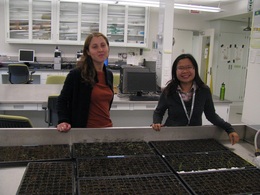
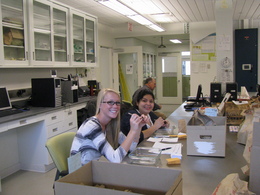
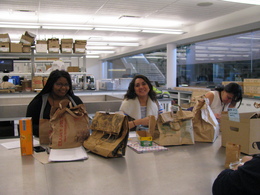
We had a lot of people in the lab last week. On Wednesday, we had volunteers Kathryn Eber and Sam Goldman along with a group of interns from Lakeforest College:
The Lakeforest students will return for two more afternoons–or longer if they so choose.
In other news, we are nearly finished counting the seeds from the 4000s batch in the 2011 harvest. For this batch, we are trying out a new protocol for selecting a random sample of seeds to weigh. Volunteers Suzie and Susanne were the first to implement the protocol and have given us some good feedback.
Every year the Echinacea Project collects all of the flowering heads from the experimental plots and processes them in the lab. Considering this process managed and completed by different people every year, it is challenging to keep everything organized from year to year.
One of our goals this year is to wrap up data collection on Echinacea seed heads from 2009 to 2011. Last year, Northwestern students Karen Taira and Ricky Rivera spent many hours organizing data from 2009 and 2010. They solved a lot of mysteries, including mislabeled heads, mislabeled files, and files saved in weird places. Last week I picked up where they left off. We are down to one box of mysteries–seeds that still need to be scanned, counted, and weighed. Once we finish with this box, we will have all our data from 2009.
In other news, a class from Lakeforest College is coming to the Chicago Botanic Garden for a mini-internship program. Karen, Stuart, and I will all be mentoring students for the next few weeks in projects related to our research. We will introduce the students and update their progress on the flog.
Lastly, this week we said goodbye to volunteer Art Abt as he prepared for his winter migration to warmer climes. We will miss him and his expertise in seed weighing.
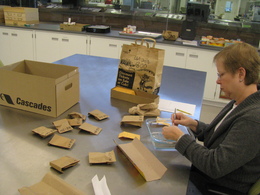
Suzanne Turner foing inventory on 2012 Echinacea harvest.

Bill Wallin Counting
Based on the flog, it may seem that the lab activity has been consumed with counting seeds and identifying ants. However, I should point out that there are some real live plants in the lab as well.
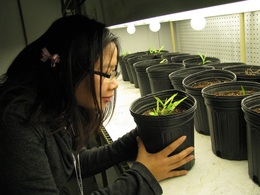
Maria has been lovingly tending her Dicanthelium plants that she germinated last fall. One of the perks of working at the Chicago Botanic Garden is the high-tech growth chamber that allows you to control light, temperature, and humidity on a programmed schedule. Maria has programmed the chamber to approximate fall in Minnesota.
Any one at CBG can use the growth chamber for their research. Anna Braum, a grad student at Northwestern, is growing host plants for her experiment on the parasitic plant Castilleja coccinea–also known as the indian paintbrush. Here she is watering her plants (with help from Maria).
We made a lot of progress this week. First, the volunteers finished the first round of counting for one of the larger experimental plots. There are still two more rounds of counting to finish, but we’re mostly there.
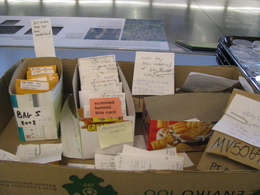
Suzanne started taking inventory of the heads we harvested this year. It didn’t take her long to get through everything, considering flowering was so low this year. Out of about 500 heads, there was only one that was mislabeled. There were a few missing, but they are on their way back from Minnesota.
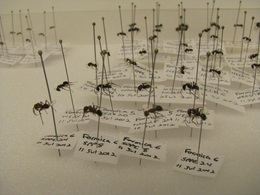
I’ve been busy trying to identify all the ant specimens we have pinned. Right now it looks like we have two species of Lasius, five species of Formica, and one species each in several other genera. There are also multiple species within the genus Myrmica, but I haven’t identified them yet. Apparently that genus is particularly difficult to identify.
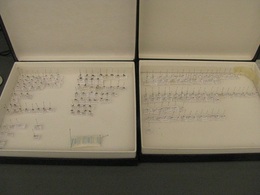
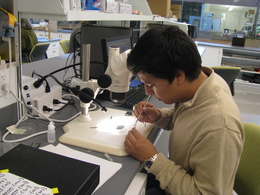
This summer, REU student Jill Gall put together a large collection of ants from prairie remnants in Minnesota. Yesterday, Stuart and I headed over to Lakeforest College to seek the advice of resident ant ecologist Sean Menke. Jill left us with two boxes of ants, which she pinned and identified to genus and separated into morphotypes:
Sean was impressed with her identification skills: she was correct in nearly every identification to genus and many of her morphotypes were consistent. He gave us some tips on what traits to look for when identifying ants. Now we have a plan for going through the rest of the collection. This will allow us to compare the species diversity of ants among prairie remnants, and hopefully pave the way for future ant research in the lab.
|
|
-thumb-260x195-136585.jpg)
-thumb-260x202-136579.jpg)
-thumb-260x202-136574.jpg)