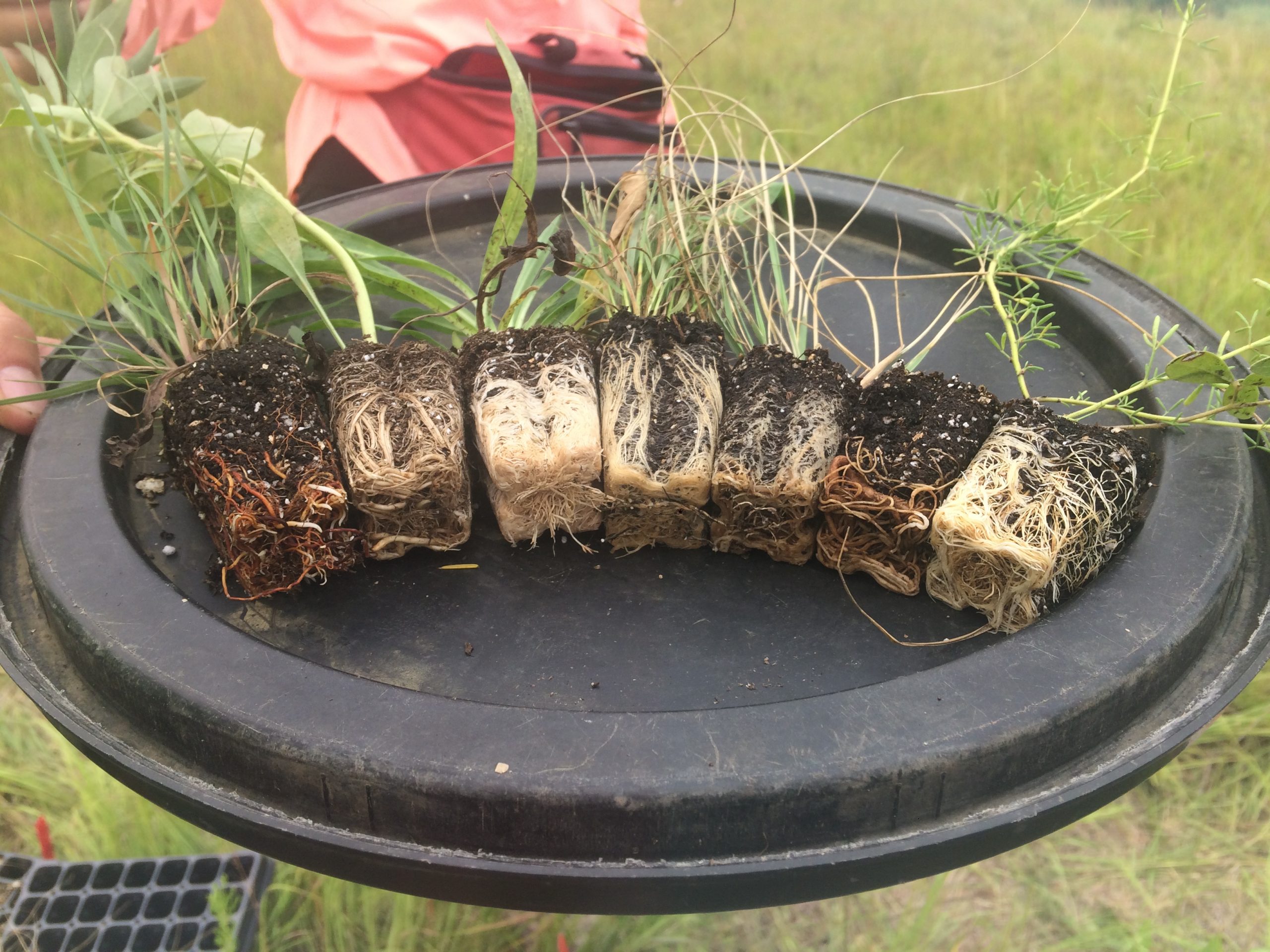
During the summer of 2019, Team Echinacea planted over 1400 E. angustifolia seedlings into 12 plots in a prairie restoration at West Central Area High School in Barrett, MN. We planted seedlings from three sources: (1) offspring from exPt1, (2) plants from my gene flow experiment, and (3) offspring from the Big Event. In summer 2021, Drake also planted plugs of other species (pictured below).
This summer, the team measured the 2-year old seedlings from my gene flow study in exPt10, as well as a few seedlings from the other plantings within the plot. The seedlings from my gene flow experiment are the offspring of open-pollinated Echinacea in 9 populations in the study area. I am assessing the paternity of these seedlings to understand contemporary pollen movement patterns within and among the remnants. In summer 2018, I mapped and collected leaf tissue from all Echinacea individuals within 800m of the study areas and harvested seedheads from a sample of these individuals (see Reproductive Fitness in Remnants). In spring 2019, I germinated and grew up a sample of the seeds that I harvested to obtain leaf tissue for genotyping.
Then, with the team’s help, I planted these seedlings in exPt10 in June 2019. I also collected seeds and leaf tissue in summer 2019 to repeat this process, but I did not germinate the achenes in the following spring because I was not able to assess seed set due to the broken x-ray machine at the CBG and then COVID-related restrictions. I hope to germinate those this spring and plant in summer 2022. I am working on extracting the DNA from the leaf tissue samples I have, which I will use to match up the genotypes of the offspring (i.e., the seeds) with their most likely father (i.e., the pollen source).
A sampler platter of seedlings, planted as part of Drake’s study of how prairie communities respond to parasitic plants.
Start year: 2018
Location: West Central Area High School’s Environmental Learning Center, Barrett, MN, Remnant prairies in Solem Township, Minnesota
In 2021, Lea Richardson conceived and initiated a 2-year study designed to test how fire affects community flowering phenology in remnant prairies in MN. We randomly sampled points in burned and unburned remnants for a total of 294 points. In a 1m radius around each random point, the number of flowering stems were counted for every plant species present in the circle twice a week from July 1-August 31. For some species, the radius extended past 1m. Random points used in this study were the same points used in the stipa project as well as other projects associated with Jared Beck’s postdoc studying fire in remnants. Lea also obtained estimates of total number of flowering plants of certain species for the whole site if the species in question was not in any of the random circles placed on the site (these additional observations should allow for more accurate flowering abundance curves to be obtained). Sites were divided into two driving routes with roughly half of the points visited on Monday and Thursday, and the other half visited Tuesday and Friday. This sampling protocol for the same sites will be repeated in 2022 to be able to compare points with and without fire across two years and among sites. Over 100 flowering species were identified within the circles. Data analysis will proceed on this first year of data in Spring 2022 and will be included as Chapter 4 of Lea’s dissertation.
Lea searches for flowering plants at a random point
Data collected: community phenology data, using visor form ptPhen (all data in aiiSummer2021 repo in ptPhen folder)
Samples or specimens collected: none
Products: [eventually] chapter 4 of Lea Richardson’s dissertation and hopefully a manuscript after 2022 data collection
You can read more about the community flowering phenology in remnants experiment, as well as links to prior flog entries about this experiment, on the background page for this experiment.
All of our summer research involves plenty of labor, with different projects requiring their own and sometimes overlapping fieldwork. This year, we devised a way of monitoring and quantifying the time spent on that labor using Excel. Designed by Wesley and primarily contributed to by Wesley and later Alex, the task efficiency evaluation kept track of time spent by 18 individuals devoted to 54 unique tasks. For example, Team Echinacea spent a total of 29,045 minutes (484 person-hours) recording the phenology of flowering plants and 4295 minutes (72 person-hours) measuring plants in experimental plot 8. The project ran from 15 Jun to 8 Oct, 2021.
Start year: 2021
Location: Followed all tasks we did in and around Solem Township
Overlaps with: Everything!
Data collected: Amount of time spent on tasks per individual. All data can be found at Dropbox/teamEchinacea2021/wyattMosiman/taskEfficiencyEvaluation
Products: Spreadsheet identifying how long certain projects took in terms of person hours.
As a part of our research looking into the role fire plays on plant reproduction and population dynamics, we collected geospatial and flowering data on Liatris aspera at 22 prairie remnants in and near Solem Township, MN. Six of these remnants burned in spring of 2021. During the growing season, we collected data on the position, inflorescence count, and number of flowering heads for over 2400 individuals (exact number is unknown still because some individuals were shot twice with the GPS due to calibration errors).
We also randomly selected 234 Liatris as focal plants, which we harvested once they had gone to seed and brought back to the lab for cleaning. We hope to be able to use the inflorescences we collected to quantify seed set and compare density effects between burned and unburned remnants.
Over the summer, Team Echinacea spent 5955 minutes (99 person-hours) shooting Liatris GPS points and 2235 minutes (37 person-hours) harvesting the focal Liatris plants.
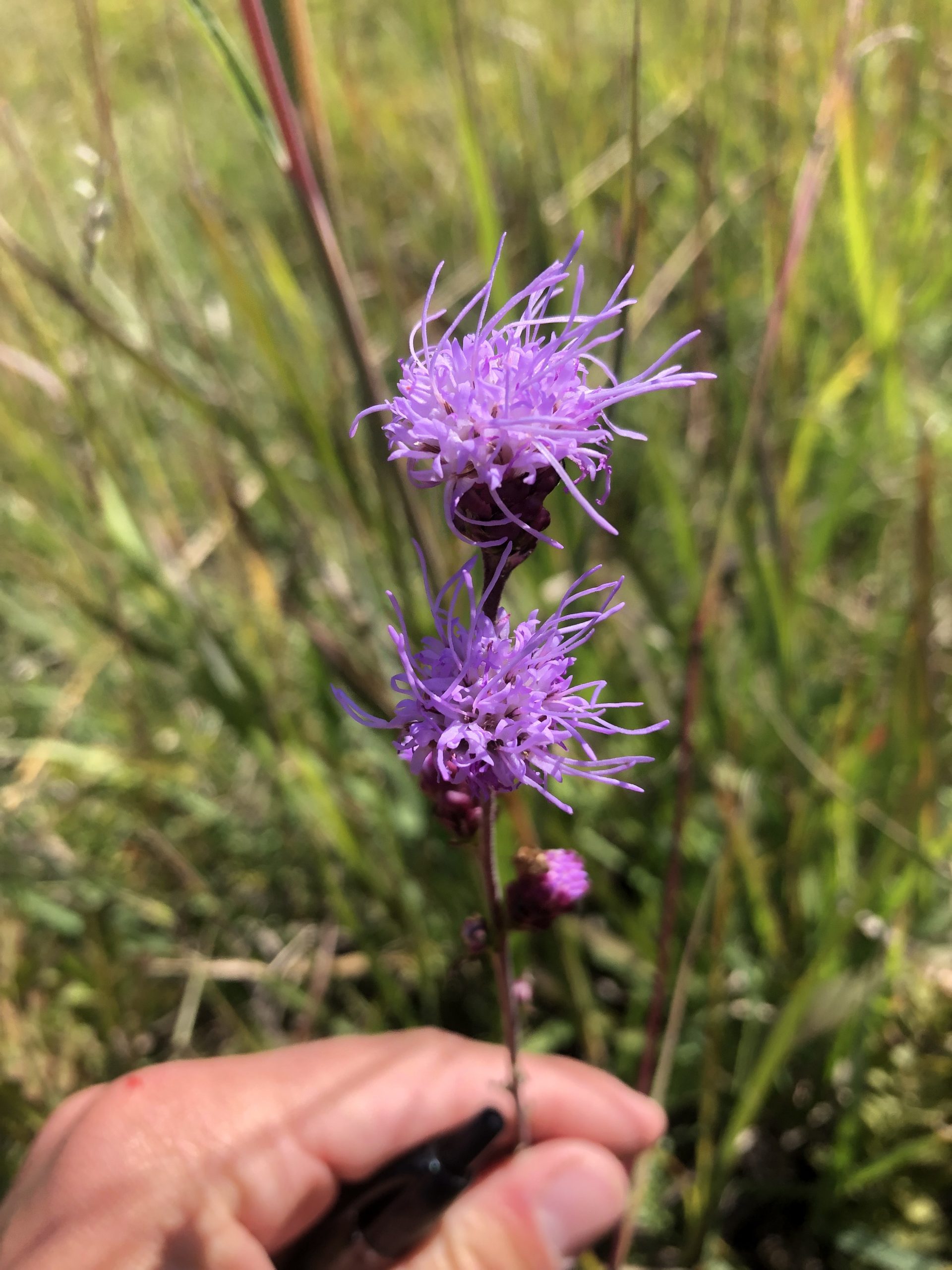
Collecting data on a small Liatris
Start year: 2021
Location: 22 prairie remnant sites in and around Solem Township, MN
For Wesley’s individual project, we made pollinator visitation observations and noted the presence or absence of other arthropods on Liatris aspera heads. Using the focal plants from the Liatris fire and flowering study, we were able to perform 95 5-minute observation periods on 84 individual plants. Most visitor identifications were made by eye in the field; however, we captured one bumblebee (released upon identification) and one fly (captured and frozen for future identification). We also recorded presence/absence data for Pennsylvania leatherwings, ants, ambush bugs, spiders, and other beetles.
All focal plants from the Liatris fire and flowering study were brought back to the lab, where the arthropod experiment is continuing via the quantification of seed predation. We have also encountered living larvae throughout the Liatris cleaning process which we hope to identify, possibly through rearing.
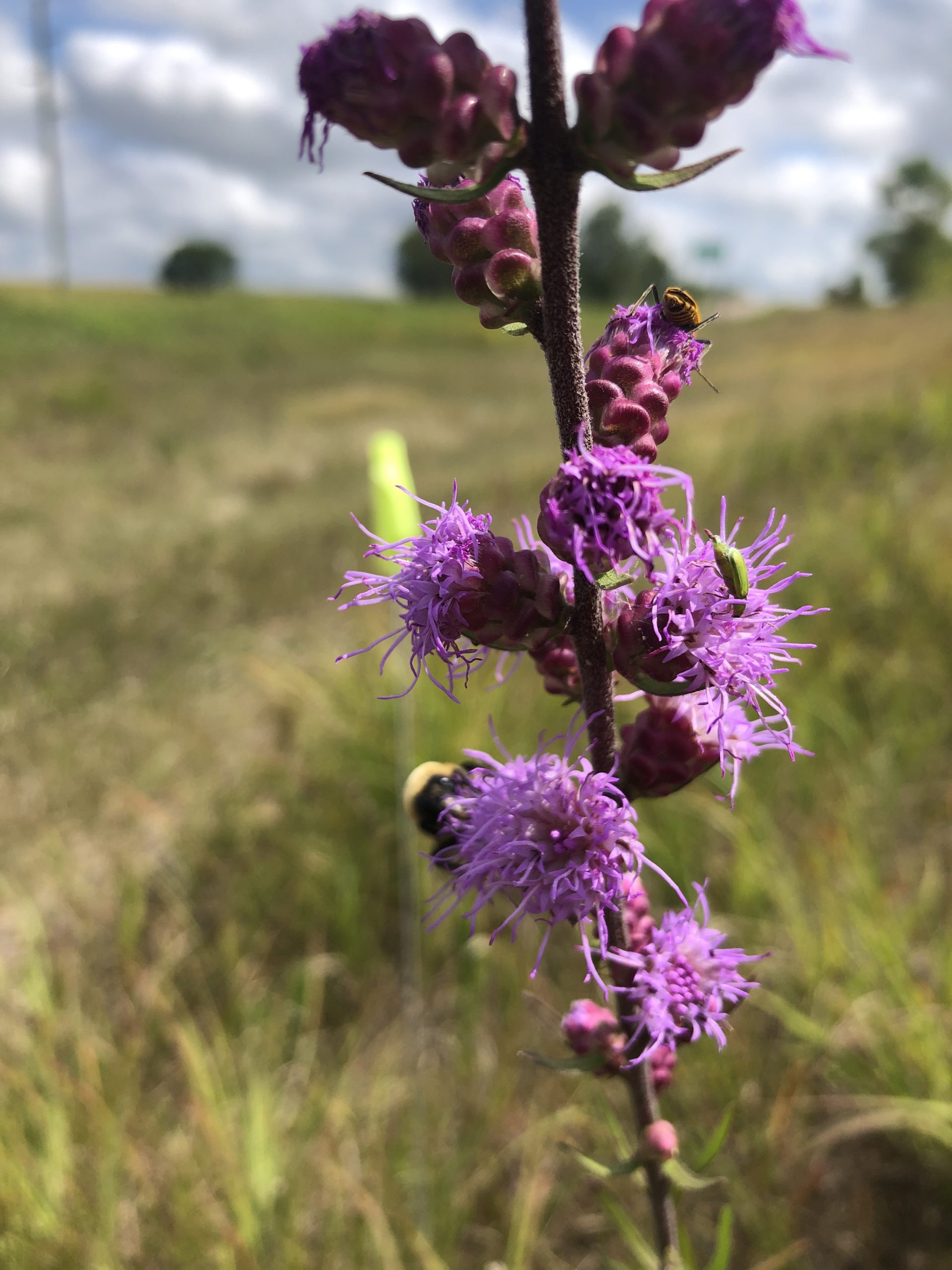
A Liatris with two beetles and a bumblebee on its heads
Start year: 2021
Location: 22 prairie remnant sites in and around Solem Township, MN
Data collected: Scanned datasheets and their typed versions can be found in ~Dropbox/remLiatris/liatrisObservations
Samples or specimens collected: 1 fly was captured for identification. Additionally, 234 focal plants were harvested. These plants are currently being cleaned and processed in the lab.
Products: Wesley’s REU was based on this project, which may at some point result in a paper or poster. Stay tuned!
This field season, the team continued the seedling recruitment experiment begun in 2007. The original goal of the project was to determine seedling establishment and growth rates in remnant populations of Echinacea angustifolia. Seedling recruitment rates are rarely studied in the field, and this is one of the few studies tracking recruitment in the tallgrass prairie. From 2007 to 2013 in spring, Team Echinacea visited plants which had flowered in the preceding year, and they searched near these maternal plants to find any emerging seedlings. Each fall since then, the team has searched for the seedlings, then juveniles, and measured them.
In 2021, Team Echinacea visited a subset of the sling plants at 12 prairie remnants from September 21st to September 29th. The team visited 62 focal maternal plants and searched for 117 sling plants of the original 955 seedlings. In total, the team found 49 basal plants, 2 dead this year’s leaves, 3 dead last year’s leaves, and 3 flowering plants! One of these heads, tag 18136 from East Elk Lake Road, was harvested and is currently being cleaned in the lab at the Chicago Botanic Garden. The team did not find the remaining 60 sling plants, and 17 of these plants have not been found for the past 3 years, so they will not be visited in 2022. No slings have been found at East of Town Hall and Northwest of Landfill for the past three years, so the team will not visit these sites in 2022. Unfortunately, after a long, dry summer, many of the plants were crispy and hard to see, especially at Riley and East Riley. Next year, the team should start hunting for slings earlier while they are still green.
This year, Team Echinacea used the visor demo form to collect data and assigned locs 301-474 to the sling plants to relate the demo form to the sling ids. To aid in finding plants next year, team members gave at tag to 53 sling plants and shot a GPS point for each tagged plant. These GPS points will then be added to the stakefile for 2022.
Over the course of 5 days, 6 people spent 1980 minutes (33 person-hours) collecting data for the sling project this summer.
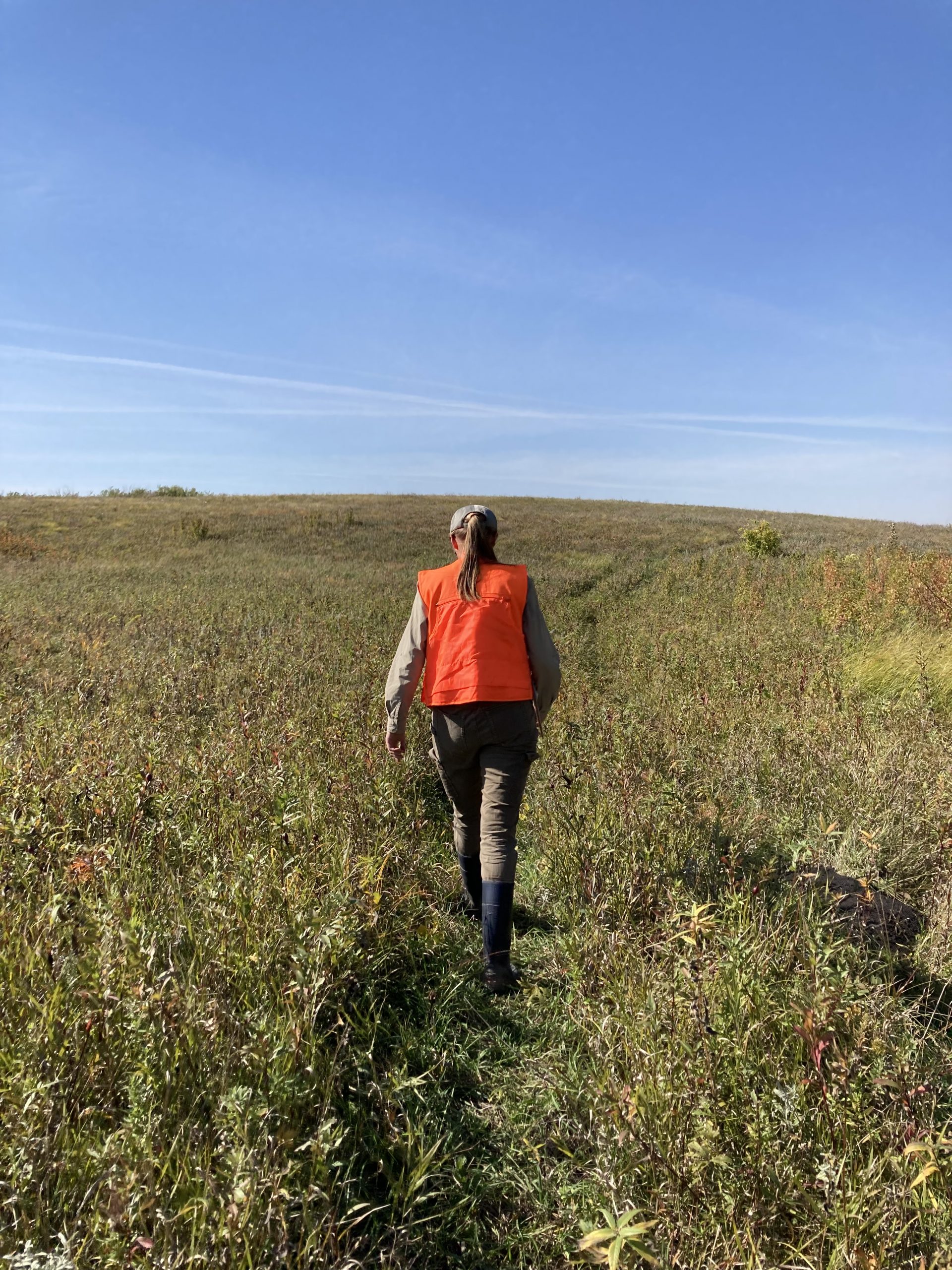
Mia hikes out to visit the slings at Staffanson Prairie West
Start year: 2007
Location: Remnants in Douglas County, MN
Sites with seedling searches: East Elk Lake Road, East Riley, East of Town Hall, KJ’s, Loeffler’s Corner, Landfill, Nessman, Northwest of Landfill, Riley, Steven’s Approach, South of Golf Course, Staffanson Prairie
The data were collected on a visor using the demo form. The team recorded plant status (can’t find, basal, dead this year’s leaves, dead last year’s leaves, flowering), number of rosettes, leaf count, nearest neighbors, and head count, if flowering.
The 2021 sling materials such as maps and scanned datasheets are here: “Dropbox\burnRem\remData\115_trackSeedlings\slingRefinds2021”
The 2021 data from the demo form are here: “Dropbox\burnRem\remData\115_trackSeedlings\slingRefinds2021\slingRefindsData2021.csv”
The 2021 stakefile can be found here: “Dropbox\geospatialDataBackup2021\stakeFiles2021\sling2021stakeV.01.csv”
Samples or specimens collected: One head from East Elk Lake Road was harvested and is currently housed with the rest of the 2021 remnant harvest at the Chicago Botanic Garden
Team members who searched for slings in 2021: Amy Waananen, Ruth Shaw, Mia Stevens, Stuart Wagenius, Jared Beck, Alex Carroll
Products:
Amy Dykstra used seedling survival data from 2010 and 2011 to model population growth rates as a part of her dissertation.
Lea Richardson and Amy Waananen are both working on papers related to the sling dataset. Stay tuned!
You can read more about the seedling establishment experiment, as well as links to prior flog entries about this experiment, on the background page for this experiment.
Unfortunately, today marked the end of my externship and therefore my flog posts. I spent today giving my presentation at the lab meeting and reflecting with the team about my experience in the externship.
This presentation, aided by the slides attached below, represented the culmination of this externship experience and all I have learned from it. In order to answer the research question I posed, I needed the relevant data that I had spent the last three weeks collecting. From day one, I learned how to sequentially transform cut plant heads into data points that can be used to determine relationships like the burn effect on achene count and seed set. Yesterday, I learned how to visually represent and perform statistical operations on that data using R. Today, I practiced conveying not only my results to an audience of scientists but getting them to engage in my narrative and conclusions. Part of the presentation also included a discussion afterward about questions others had and contemplation about the reasons and implications surrounding certain results.
In particular, my presentation aimed to expand on the echinacea burn effects research done by The Echinacea Project at Staffanson Praire Preserve. I was curious whether the burn effect on production and pollination found in this study and various other published ones would hold up to recent years and to a study area beyond just Staffanson. As shown below, I found the burns performed at multiple sites resulted in a greater (statistically significant) increase in the seed set of echinacea heads at these sites than for those that were not burned. Feel free to take a look for more information and specific results:
Overall, this externship has increased my practical lab knowledge and experience in data processing. In general, it helped bolster my ability to form and carry out a research question all the way to the project’s completion. In addition to my own project, I got to participate in lab meetings and share suggestions and questions with people presenting their papers in progress. This exposed me to not only the workflow of data processing but the commonplace revision and discussion of ideas. Another thing this externship strengthened was my networking skills, as I sought out and spoke with multiple employees who gave me insight into their projects and how I can best pursue my interest in similar work. These people included land managers, like Matt and Joan, and Ph.D. program students, like Lea and Drake. The employees I directly worked with, like Alex, Mia, Wyatt, Jared, and Stuart, especially ensured that I was able to take all that I could from this externship and meaningfully contribute to their project’s progression. I am immensely grateful to have been a part of this experience and I can’t wait to someday join such a kind community and fascinating field of study.
Today is the last day of the externship and we presented our findings.
After a really intense afternoon of learning to use R and working with data on Thursday, we made some graphs and did some statistical tests on the data we have been collecting (as well as spatial data that Jared and Alex got ready for us). It was really hard because I didn’t have that much experience in R, but it was really rewarding as I learned how to make the graphs I want and do statistical tests.
I was interested in looking at tradeoffs plants make in reproduction in the first place, but then I realized that I couldn’t directly quantify resources plants put into different aspects of reproduction with the data I had. I decided to change things a bit and focus on limitations to reproduction. I set up scenarios of plant’s reproductive effort under different conditions in terms of resources and tried to clearly explain it by having hypotheses and visual aids. Another potential limitation I considered was limitation in pollination, which I quantified by looking at level of isolation based on distance to neighbors. I made a lot of assumptions which I hope are true – for example that plants really would put all the resources into reproduction, and that distances from other conspecific plants are a predictor of pollination.
I didn’t find strong evidence for any of my hypotheses except that there is a negative relationship between the distance to 3rd nearest neighbor and seed set in liatris. It was interesting but also expected – isolation seems to be negatively impacting pollination and thus seed set.
The presentation went well and these are the slides I used for it.
Overall, this externship has been a really great experience. I learned so much about the processes of doing science, about what scientists do on a daily basis and how a research group functions. I’m really glad that I got to participate in the lab meeting, explore in the Garden, be a part of many processes of research and eating lunch with the lab group everyday!
I also learned that studying plants is a lot harder than I imagined. It’s a really long process, and there are many biases that could happen. Organizing a lab takes a lot of work, and making a standardized ‘assembly line’ to process hundreds of plants every year is incredibly hard. The results or findings sometimes are not what you expected, or don’t seem to make sense at all. These are all things that I never imagined to be a part of studying plants and ecology. I feel like now I have a much better idea of what the field is like and what to expect moving forward from here. I am really grateful for this experience and for everyone who made it possible.
As the three weeks of my externship at the Echinacea Project comes to a close, I’ve learned a lot about the research process and the different stages of a scientific investigation. After coming up with my main research question about density and seed predation in Liatris a couple of weeks ago, I have since been working on cleaning and randomizing Liatris, as well as quantifying seed predation in order to analyze the relationships I wanted to investigate.
After going through all the steps of getting my data ready for analysis, I got to do some data visualization and statistical tests to fully analyze the results of my project. This was done in R, where I make several graphs and ran statistical tests such as t-tests and generalized linear models.
After getting to analyze my data, I put together a presentation summarizing some of my findings and my thoughts about them. To summarize, my main research question was investigating whether the fire-induced density of flowering Liatris plants influenced seed predation, and I hypothesized that burning would lead to higher density, which would lead to higher seed predation. I found that burning did in fact lead to a higher density of Liatris plants, but there was not a significant relationship between nearest neighbor distances and seed predation, with only a very slight negative relationship between the two. There was a steeper relationship between the two in just burned plots versus unburned plots, which I thought was interesting, although I am unsure about why this is the case.
Overall, I found that the reproductive benefits of fire do not seem to be outweighed by the threats posed by seed predation, which is good news for those that want to use fire as a tool for prairie management and conservation. My entire presentation, with background information and the graphs I used, can be found below!
Overall, this experience has been very insightful into the world of scientific research, as well as all of the methodologies and tools necessary to successfully complete a project and gather meaningful data. I’ve learned first-hand the importance of things such as random, unbiased samples, having a thorough, detailed protocol, and having organized workflows and data collection methods. I have also had the opportunity to meet and talk to people pursuing ecological research and learn about that process, which has been super helpful. I think that one of my biggest takeaways from this externship is that you don’t have to have all of the answers and that there are always more questions to investigate.