Each year, we assess flowering phenology in experimental plots to determine mating potential for individual plants and see how a number of factors may affect flowering phenology. Some of the factors we have investigated in the past include heritability, burning, and climate.
2019 was truly a special year for Echinacea flowering phenology in experimental plots. There were flowering plants in four – yes FOUR – experimental plots. We had the usual flowering plants in exPt1 and exPt2 at Hegg Lake. We also had a flowering plant in exPt8 (qgen2 and qgen3) and exPt9 at Hegg Lake. Unfortunately, we did not see the flowering plant with an E. pallida dam at exPt9 until late in the season, so we did not take phenology in exPt9.
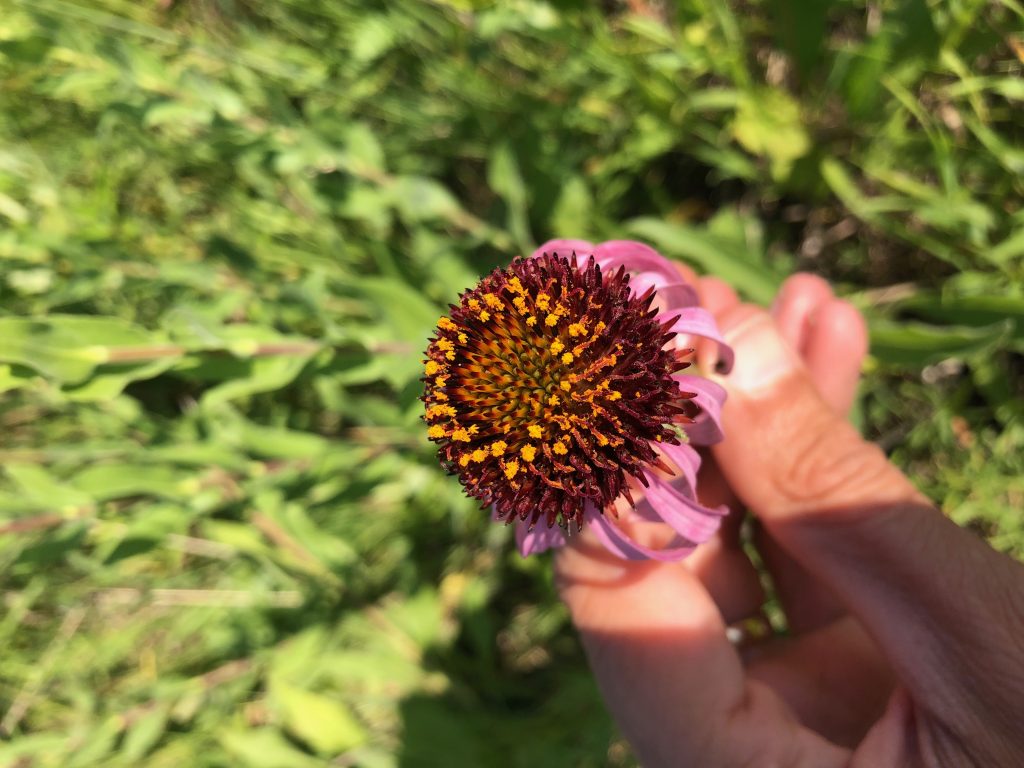
This Echinacea head is mid-flowering. It has more than 2 rows shedding pollen and more than 11 immature florets.
This year, we visited the three other plots and followed the usual Echinacea phenology protocol. We recorded first flowering day and subsequently recorded dates of “mid” and “late” flowering. Finally, we recorded the final flowering date of each plant.
In addition to the single flowering plants in exPt8 and exPt9, exPt1 had 63 flowering heads we tracked for phenology and exPt2 had a whopping 1207! The first flowering head in exPt1 started on July 3rd, while the first head in exPt2 started flowering on July 1st. The last day of flowering in exPt1 and exPt2 was August 21st. What a long summer of taking phenology data!
Data/
materials collected:phenology data (start date, mid flowering, end date,
etc…), harvested heads for the ACE protocol. All phenology data can be found in
the cgData repository in the subfolder p1p2Phenology.
Echinacea pallida is a species of Echinacea that is not native to
Minnesota. It was mistakenly introduced to our study area during a restoration
of Hegg Lake WMA. Since 2011, Team Echinacea has visited the pallida restoration and taken flowering
phenology and collected demography on the non-native. This year, we decapitated
all flowering Echinacea pallida to
avoid interspecific pollination with the local Echinacea angustifolia. We fear that Echinacea hybrids may be infertile, so we want to avoid the
establishment of as many hybrids as possible.
This year, a team slogged through the Hegg Lake restoration to find flowering Echinacea pallida. We recorded the number of heads on each plant, the number of rosettes (some plants were absolutely massive), shot gps points at all plants, and then chopped the flowering heads off! We visited the restoration and cut E. pallida heads off on July 8th, 9th and 10th of 2019. We revisited plants and shot gps points for them on July 11th, July 12th, and August 1st.
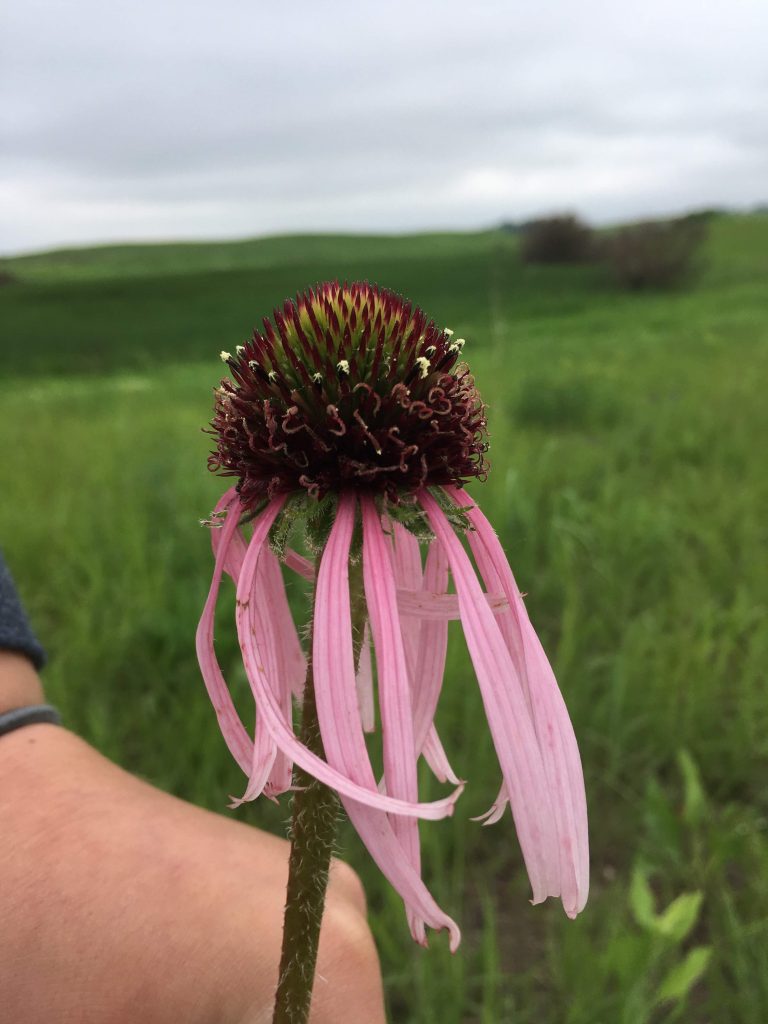
You can distinguish E. pallida and angustifolia heads by pollen color; E. angustifolia has yellow pollen, but E. pallida has white pollen (above).
Overall, we found and shot points
for 97 flowering E. pallida. On
average, each plant produced 2.5 flowering heads. That’s way more than an
average E.angustifolia!The average
rosette count was 5.4, another big number! The largest plant had 23 rosettes.
We collected tissue samples of E. angustifolia, E. pallida, and known hybrids so Elif can assess ploidy at the Chicago Botanic Garden using the flow cytometer.
Start year: 2011
Location: Hegg Lake
Wildlife Management Area Restoration
Data collected: Demography data, head counts, rosette counts, gps points shot for each E. pallida. Cut Echinacea pallida heads, tissue samples for ploidy analysis. Find demo and phenology visor records in the aiisummer2019 repository. Phenology visor records were taken when we cut heads and demography records were taken when we shot GPS points. GPS points can be found in Demap.
In summer 2019 Team Echinacea continued the aphid addition
and exclusion experiment begun in 2011 by Katherine Muller. The original
experiment included 100 plants selected from experimental plot one to have
aphids added and excluded through multiple years. The intention was to assess
the impact of specialist herbivore Aphis echinaceae on Echinacea fitness.
This year Erin and Shea managed the project. They located 15 living addition plants and 22 exclusion plants. The experiment was conducted from July 8th to August 16th. Erin and Shea performed addition and exclusion twice a week for a total of 10 events, with the final visit consisting only of observation. The number of aphids applied to each plant depended on how many could be obtained and varied between five and 10. They recorded the number of aphids present in classes of 0, 1, 2-10, 11-80 and 80<. They also recorded the precise number of aphids added. Erin and Shea found that natural hair paintbrushes were more effective than synthetic and trimmed the brushes down so fewer than half the hairs remained.
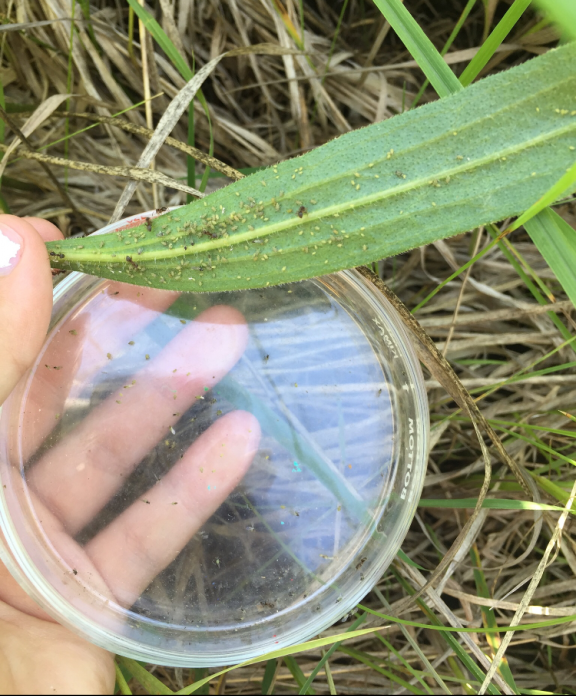
Aphids were gently pushed into petri dishes using paintbrushes
Data collected: Scanned
datasheets are located at ~Dropbox\teamEchinacea2019\aphidAddEx2019\aphidAdEx2019Datasheets.pdf.
The paper sheets are located in the CBG common area filing cabinets in a
manilia folder labeled “Aphid ad/ex 2019,” located next to the 2018 aphid
folder.
Products:
Andy Hoyt’s poster presented at the Fall 2018 Research Symposium at Carleton College.
2016 paper by Katherine Muller and Stuart on aphids and foliar herbivory damage on Echinacea
2015 paper by Ruth Shaw and Stuart on fitness and demographic consequences of aphid loads
You can read more about the aphid addition and exclusion experiment, as well as links to prior flog entries mentioning the experiment, on the background page for this experiment.
Three weeks have gone by fast! It’s pretty incredible how much we were able to fit into such a short time span.
Our first week was spent getting introduced to the center and the work happening here. We met lots of people as well as lots of lab equipment! We learned how data collection happens for the study of Echinacea, by completing a large set of Echinacea achene counting using new study protocols. This study will hopefully yield interesting insights into how Echinacea plants develop and utilize resources. We also learned how XRays are used and processed (RIP to the XRay machine, gone but not forgot), and spent some time helping organize Echiachea heads for later use.
Our second week, we continued the organization and processing of Echinacea data but also began to develop our own research inquires, based on our own personal interests and the data we had to work with. We all chose very different focuses, mine being a focus on long-term analysis of pollinator diversity and abundance measures, or “How are bee populations changing over time in the Echinacea fields?”
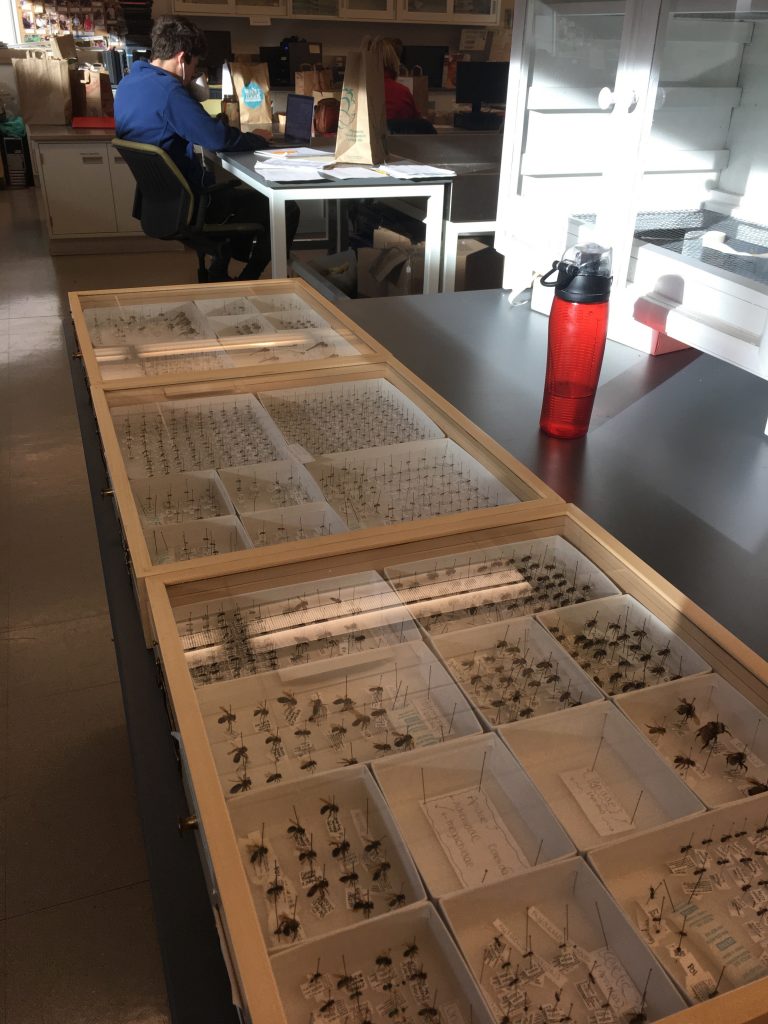
Bee samples that provided me with data for my work
Our third week, we focused in on our projects. Locating and processing my pollinator data took a good deal of time, so I spent a good chunk of the week processing this data as well as learning R, a widely applicable skill for someone interested in science. While I still have a lot of questions and things I’d like to explore further, I am very happy with what I was able to accomplish given the time constraints. Please see my attached presentation below for more detail and major takeaways!
I would like to give a huge thank you to Stuart, Erin, and Riley, who made this entire experience possible. They helped us pretty much every step of the way, whether it was practicing our ‘ABTs’s, scanning seeds, or learning R from the ground up. I am very happy to have had such a productive and fulfilling winter break and look forward to more breaks, and more work like it.
I have very much enjoyed my time here, and after 3 weeks of work am looking forward to the holidays with family, and sleeping in past 6am!
In 2019 100 plants were selected for a flowering induction experiment using liquid smoke at site ALF. They were shot with GPS Darwin. Many of these plants lie beyond boundary fence and are not included in demo/surv. However, records containing a “loc” (numbered 1-100) and the number of heads per plant were taken on visors with the demo form and added to the 2019 demo data. The shot points were not added to surv. The experiment was not executed in 2019.
The demo records were added to aiisummer2019 in file ~aiisummer2019\demo\20190726demo.txt.
Job SMOKE_PLANTS_20190726_DARW contains 100 points shot of plants for the experiment. The job is backed up in three locations:
In 2019 Jennifer Ison tracked and sampled ground nesting bees in Exp. Plot 2 with Miyauna Incarnato, Avery Pearson and Ren Johnson from the College of Wooster. Bees were captured, refrigerated, fluorescent dyed, released and tracked to their nests. Several bee nests were located and shot with GPS Darwin. One was excavated and brought back to Wooster for study.
Job BEENESTS_20190730_DARW contains 13 points shot of nests and their surrounding plants. The job is backed up in three locations:
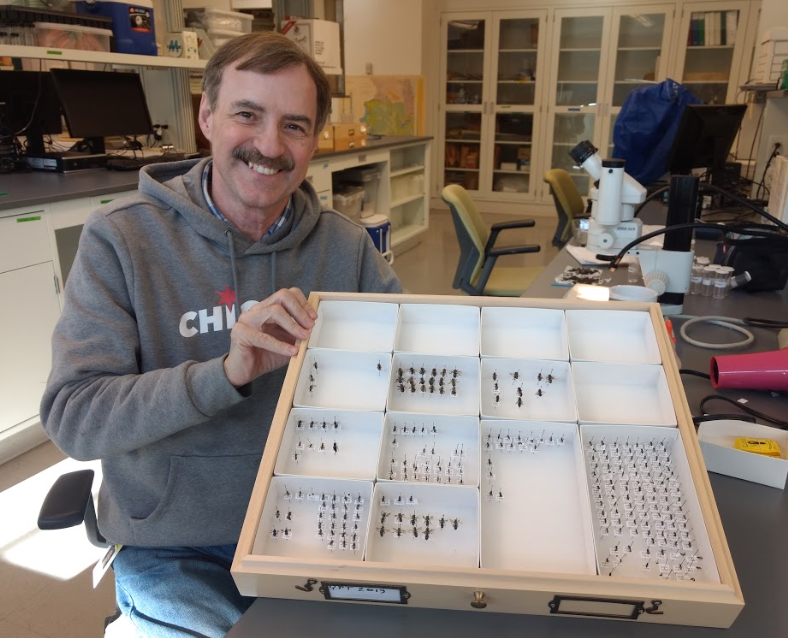
This summer Shea and John continued our yellow pan trap project to sample the pollinator community found along roads in our study area in Minnesota. Today volunteer Mike Humphrey pinned the last bee from this summer’s collection!
Mike with the collection; next he’ll be consolidating these with Shea’s pinning from this summer to be sent off for ID at the University of Minnesota!
Mike received a surprise on his last day of the year; volunteer Char found a desiccated bee in one of the Echinacea heads she was cleaning! Mike reports it’s different from anything else we have in the collection this year, so a seriously cool find.
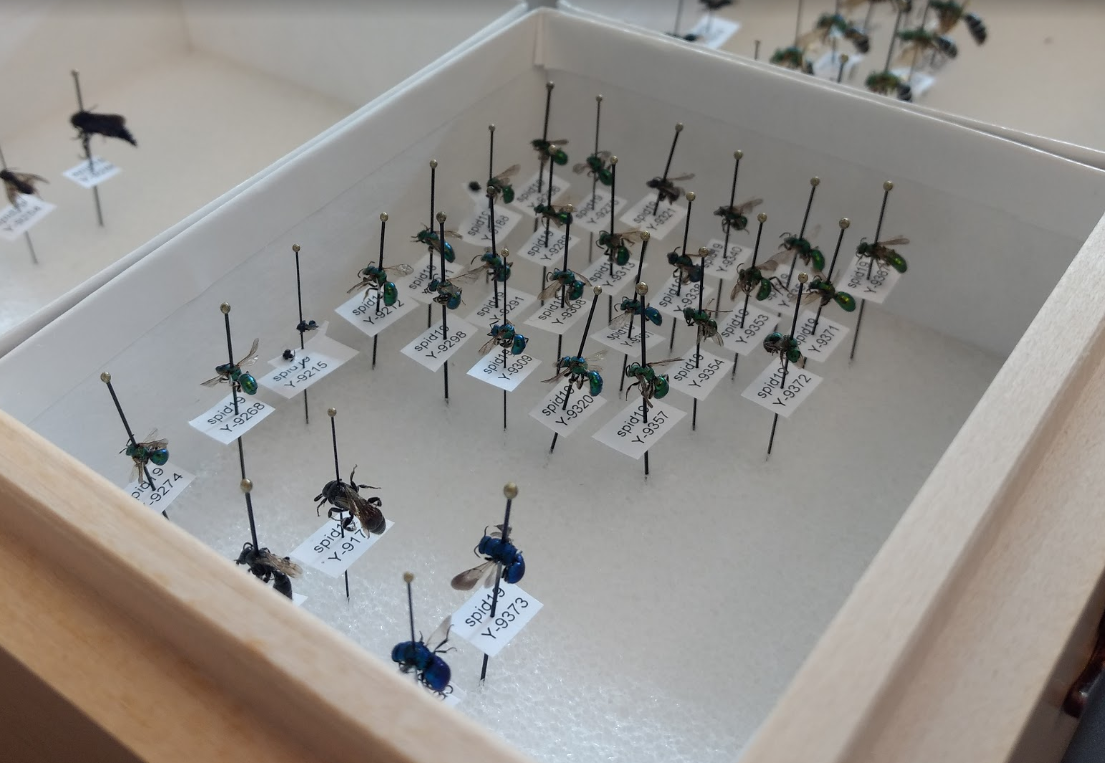
A majority of the bees in our 2019 collection are unremarkable Lasioglossums that we call “small black bees,” but we also get remarkably shiny blue and green bees in our traps!
Thanks for all your hard work Mike, and we’ll see you next year!
Last Friday, I was dispatched by Stuart to find the number of plants/ achenes planted in each experimental plot, along with the number alive as of a recent year (2017-2019, based on the plot). Although records of some plots were a bit harder to come across that others, I was able to compile data from each plot (besides p10 – planted 2019 – data coming soon). This would not have been possible without the help of Gretel, so thanks GK! I have attached a small datasheet with the survival data.
In the history of the Echinacea Project, the team has sown 31,888 Echinacea viable achenes in experimental plots. There were many more sown that likely did not have a seed. Team members found 3634 seedlings from these seeds, not including Amy D’s experimental plot 3 and remnant seedling refinds. The team has planted 18,869 Echinacea seedlings in experimental plots, not including p10 – planted at West Central Area HS in 2019. Finally, 7090 Echinacea are currently alive in the experimental plots!
This is going to be a joint flog post for Sunday and Monday (mostly Sunday…).
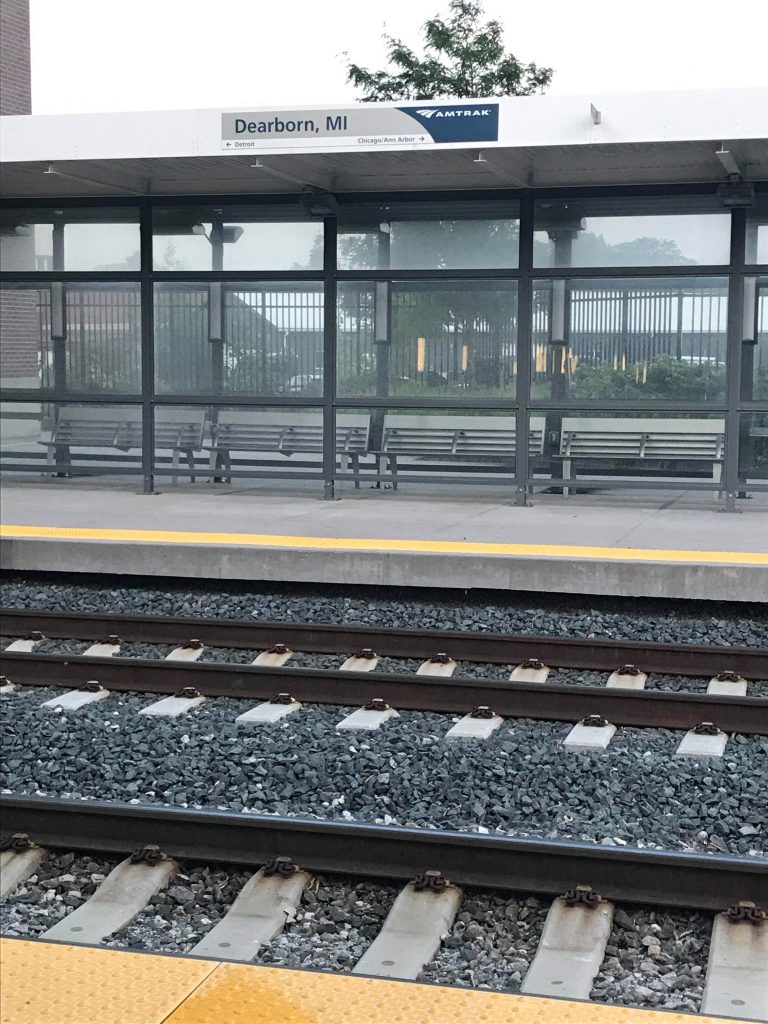
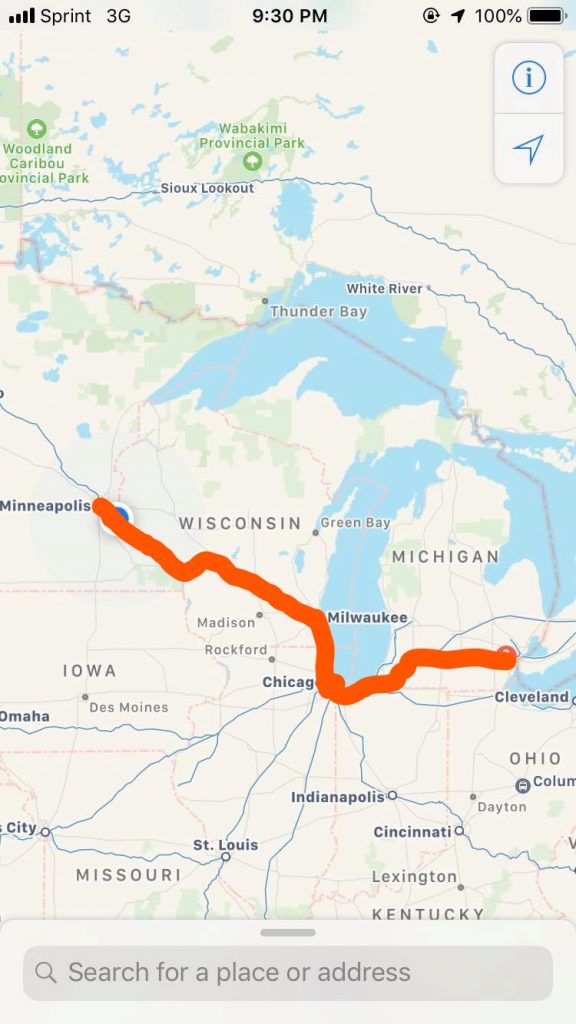
Sunday was a travel day for me. I woke up at 5:30 am and hopped on the Amtrak train in Dearborn, Michigan and headed back to Chicago, Illinois.
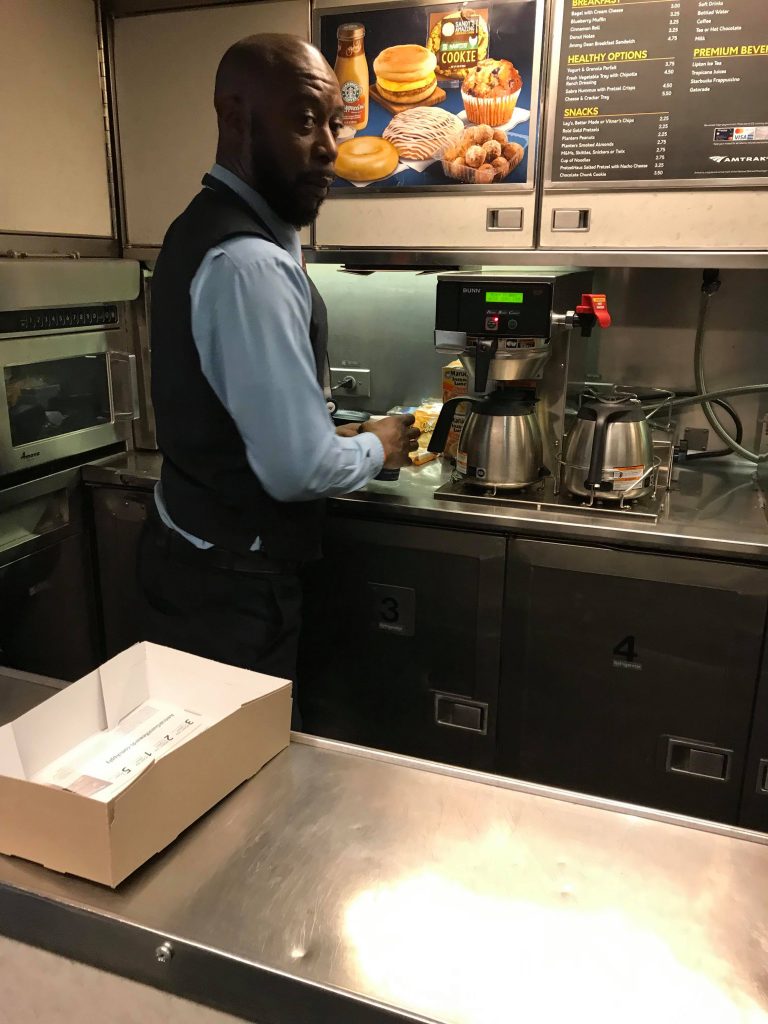
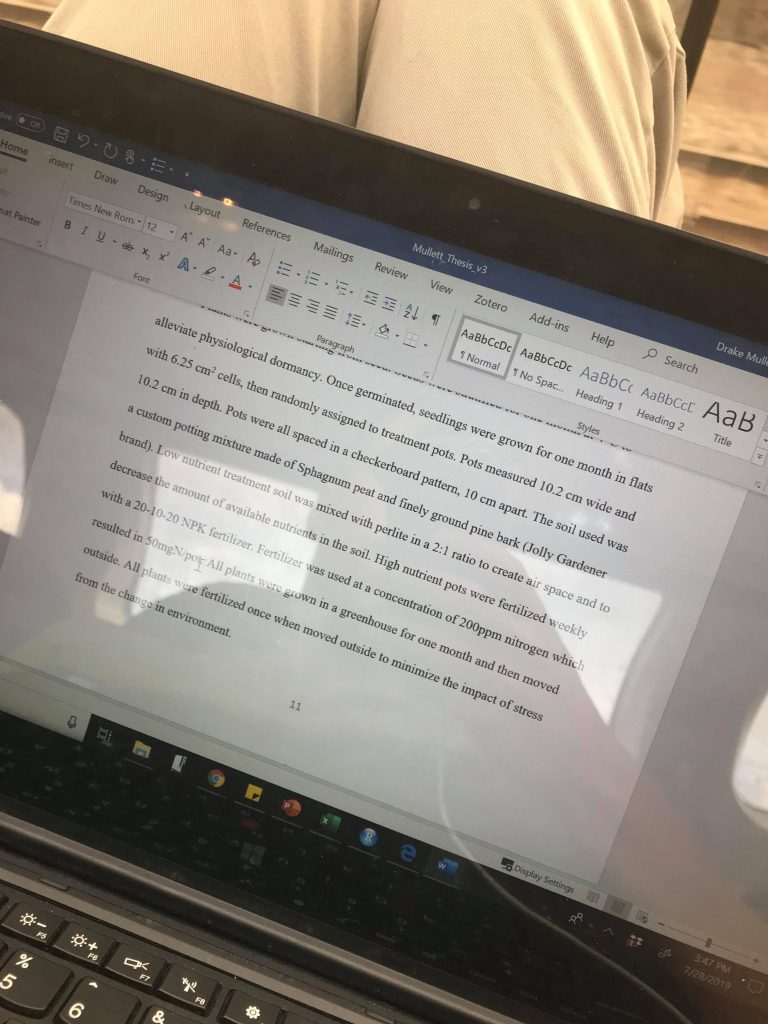
While on the train I worked on revisions for my Master’s thesis and worked on a poem while I drank my coffee.
Thank you Amtrak Employee for the coffee.
When I arrived in Chicago, I had two hours to kill before my next train. So, I grabbed lunch at Chipotle and hung out in the main hall of Chicago’s Union Station.
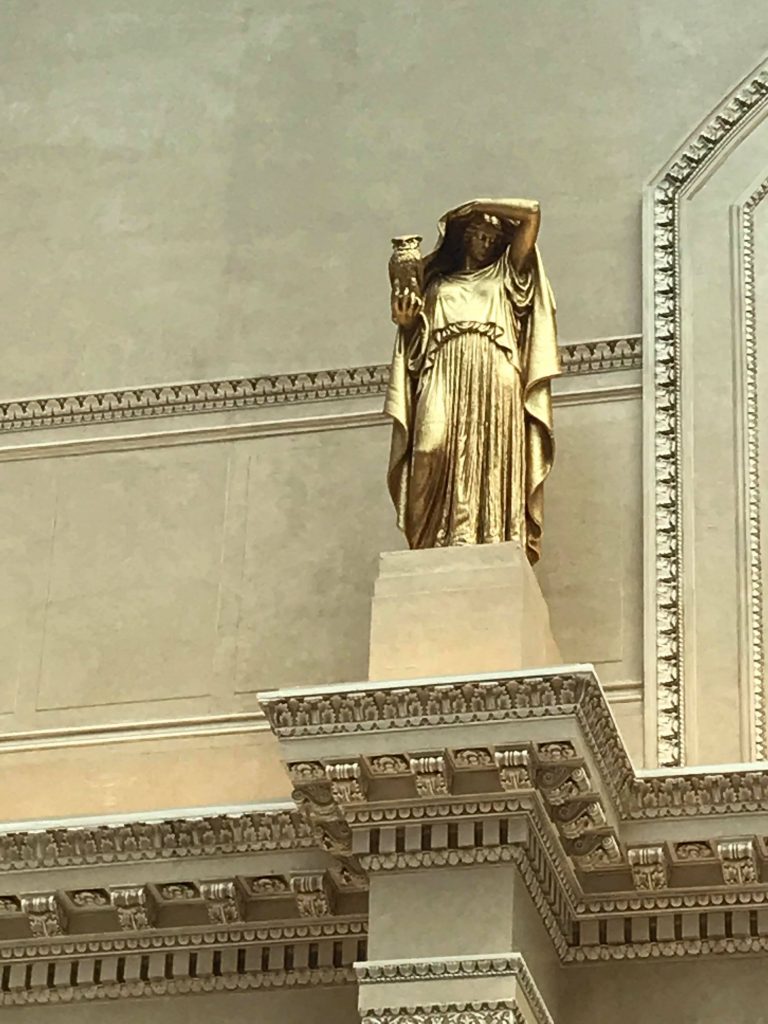
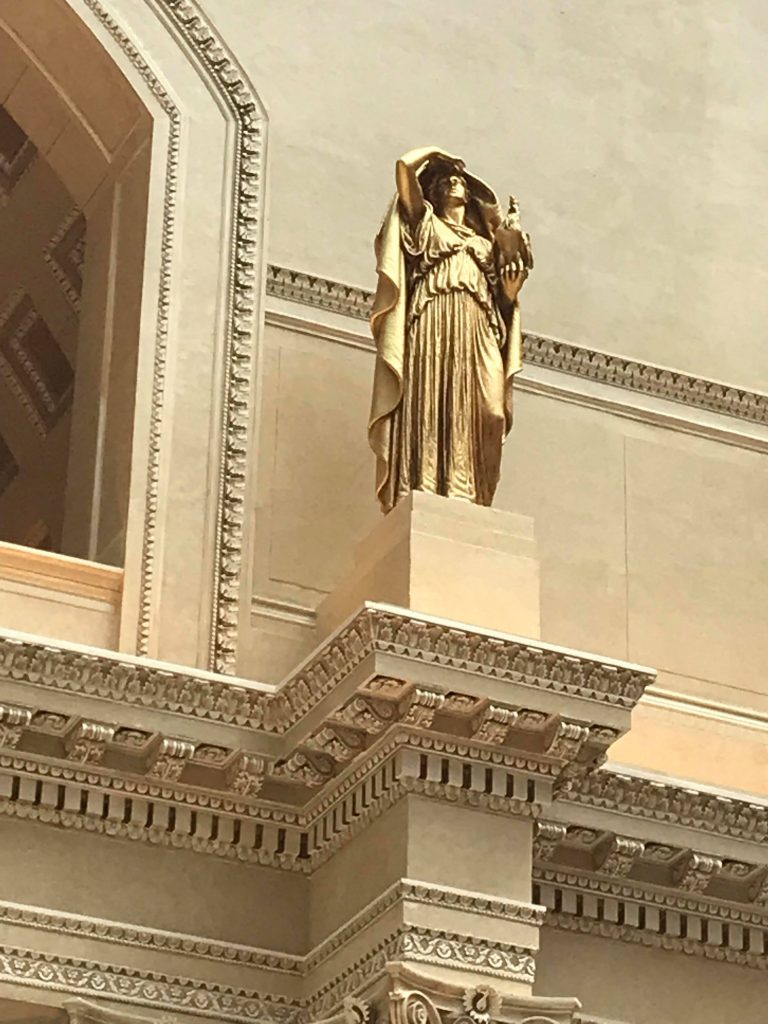
These statues at Chicago Union Station are supposed to represent Night and Day.
While on the train from Chicago to Minneapolis, Minnesota I worked on my Master’s thesis some more.
My Amtrak trek from Dearborn, MI to Minneapolis, MN.
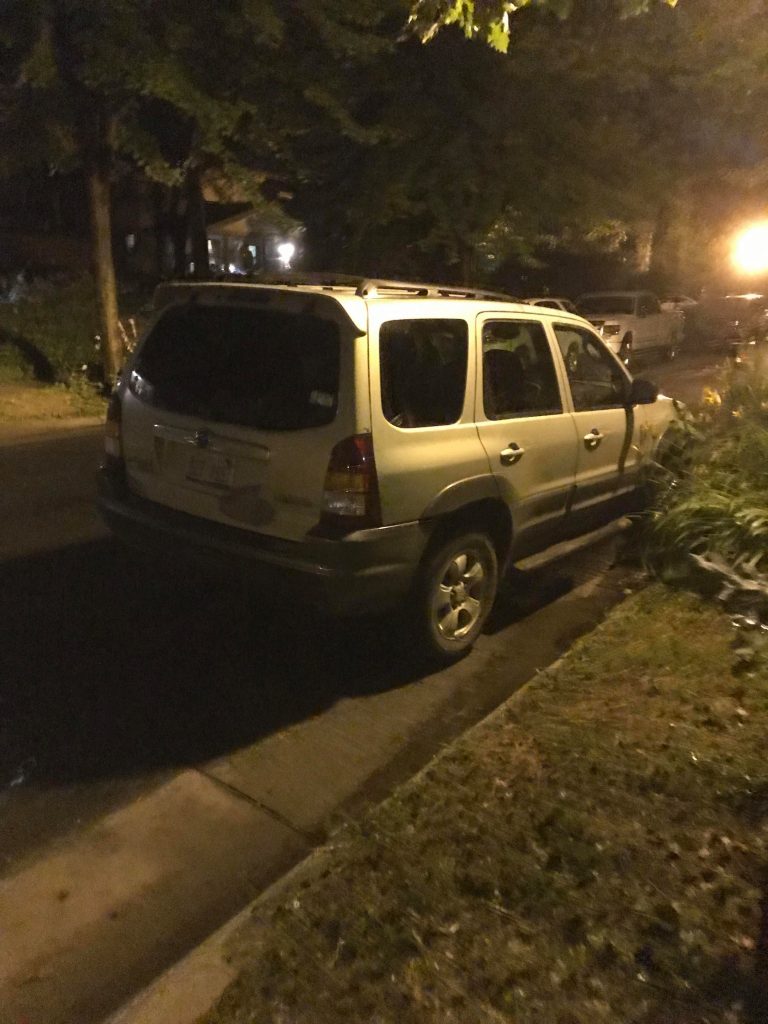
When I arrived in Minneapolis I had to take the Green Line to Stuart’s brother’s house. This is where I left my car while I was out of town. So, here is a thank you to him and his family for that!
No tickets or tows There went my remaining woes I am so thankful
Finally arrived in Kensington, Minnesota around 1:15 am and in bed by 2 am.
Woke up Monday and got to work with Team Echinacea after my week away! We went out to Experimental Plot 2 and took phenology data and administered our pulse/steady pollination treatments.
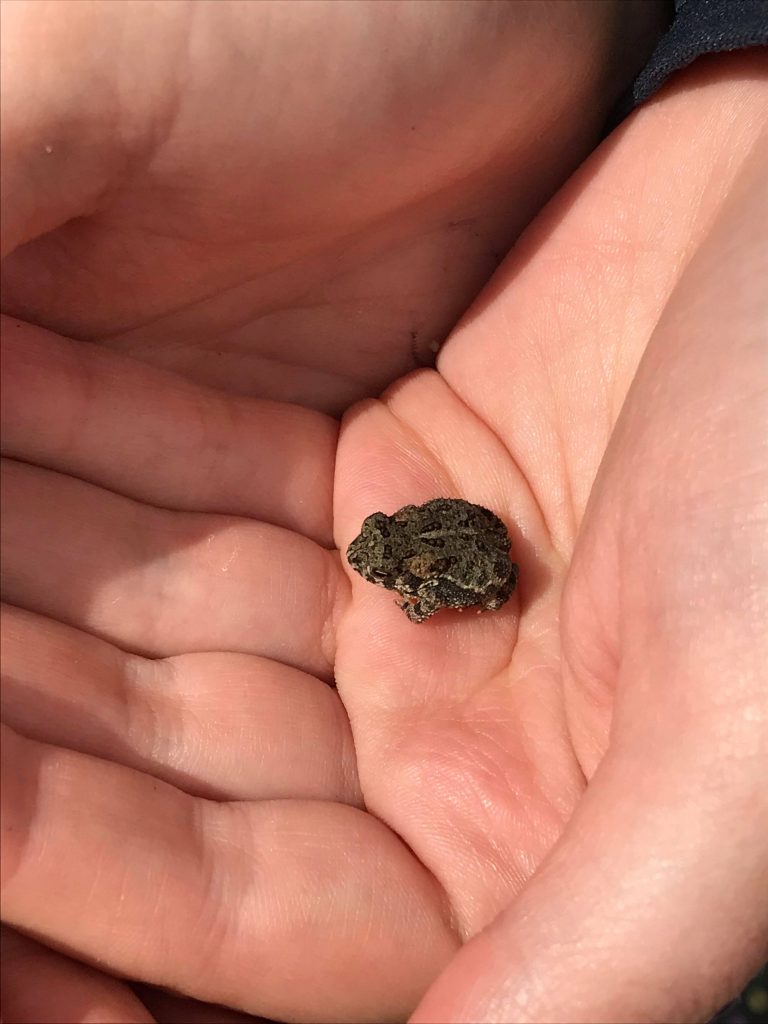
Julie found a toad.
After work in P2 I went out to Riley and collected seeds.