|
|
Spring is a hectic time for most biota; interns are no exception.
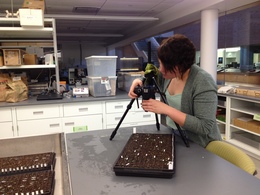
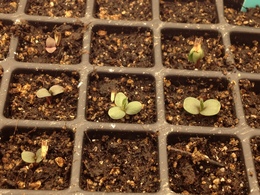
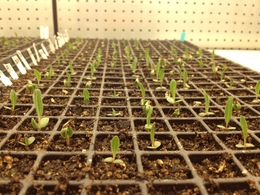
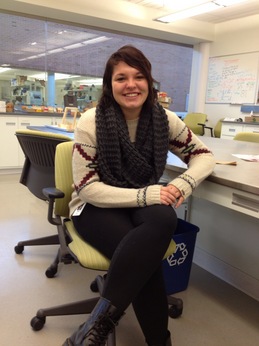
The lab currently has two undergraduate interns working on separate projects. Jill Pastick (Lakeforest College) is studying hybridization between native Echinacea angustifolia and non-native Echinacea pallida in Minnesota. This project began with Nicholas Goldsmith, who performed a hybrid crossing experiment in the summer of 2011 and observing pollination success based on style persistence. Shona Sanford continued his project by performing a second crossing experiment in the summer of 2012 and weighing achenes to determine whether or not they contained seeds. Jill is continuing the project by the germinating the achenes from Shona’s study to assess their survival and growth. She is currently photographing the seedlings to take detailed measurements on size and color.

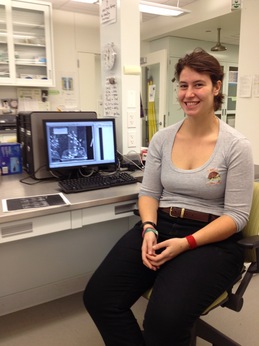
Our other intern, Gia Hallaman (Northwestern), returned to the lab this week after spending her spring break volunteering on an organic farm in Wisconsin. She is in the process of curating and identifying ants collected by Jill Gall in the summer of 2012. Jill’s collection covered 6 prairie remnants throughout Douglas County Minnesota. So far, Gia has identified a subset of ants from all 6 sites. For her project, she is going to focus her effort on the Staffenson prairie preserve in order to compare the ant community in the burned and unburned units.

Hi everyone,
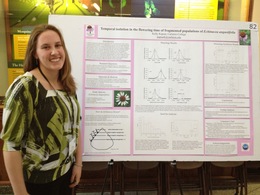
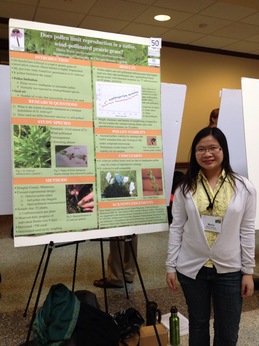
I presented a poster at MEEC 2013 (which Katherine wrote on in the previous entry) and just got back from another poster presentation at Chicago Area Undergraduate Research Symposium (CAURS) today!
Here’s my poster – enjoy looking at it to see what I found out from my summer fieldwork!
Wang_MEEC2013-Poster36x44-pdf.pdf
Greg Diersen gave an oral presentation “Pollinator Collecting for the Lab and Classroom” at the Life Discovery – Doing Science Inaugural Education Conference on Mar 15-16 in St. Paul, Minnesota.
As a science teacher participant in the Echinacea project through the National Science Foundation RET program, Greg developed a lesson plan for experimentally pan-trapping pollinators to use in secondary and post-secondary biology classes. This experiment offers diverse opportunities for doing science, learning biological concepts, and understanding about our changing world.
Greg was a high-school science teacher for 16 years and is now a professor of biology at Martin Luther College in New Ulm, MN. diersegtATmlc-wels.edu
This past weekend, three students associated with the Echinacea Project presented their work at the Midwest Ecology and Evolution Conference at Notre Dame.
Kelly Kapsar (Carleton College, 2014) spent the winter analyzing her data on flowering phenology in prairie remants and presented her results in a poster.
Maria Wang (Northwestern, 2013) presented the results of her undergraduate honors thesis on pollen limitation in the prairie grass Dicanthelium.
Master’s student Katherine Muller gave an oral presentation on her research on the relationship between Echinacea and its specialist aphid.
I should mention that Maria was recently accepted as a Master’s student in the Northwestern Program in Plant Biology and Conservation. She will graduate this summer and remain in Chicago another year to finish her M.S.. She will be working with Dr. Nyree Zerega investigating the genetic origins of tropical crops. Although we will miss her in the Echinacea Project, we wish her the best in her next endeavor.
This week marks several milestones in the lab. First, the volunteers completed randomizing and weighing achenes from the 2011 harvest of a large experimental plot planted in 1999. This experiment looks for genetic differences among maternal populations by combining their offspring in a common environment and measuring a variety of traits, including seed set. Weighing is the last step in data collection for this experiment. Although we have a long way to go in processing 2011 data for other experiments, we are making good progress.
Another milestone this week is the launch of our new online data entry system for achene counts. Bianca Rosenbaum, the web developer at the Chicago Botanic Garden, has created an interface that allows volunteers log into the website, open scanned images, and enter data into a web form. In addition to doing away with paper datasheets, this will improve our ability to catch mistakes, such as mis-labeled scan files. Anne Coughlin was the first volunteer to try the new system.
In other news, intern Jill Pastick has begun the pre-germination phase for an experiment assessing the growth of Echinacea angustifolia x pallida hybrids. This will add to Shona Sanford’s work on style persistence and seed set of hybrid crosses. Click the link to read about Shona’s most recent findings on Echinacea hybrids: (https://echinaceaproject.org/wp-content/uploads/2013/02/more-work-with-e-angustifolia.html).
Every so often, an Echinacea seedling emerges with an extra cotyledon. I introduce to you, the tricot:
These are the seedlings from Jill Pastick’s experiment comparing Echinacea germination in agar vs. blotter paper. That picture was from last week (Feb. 19). Here is what they look like today (Feb. 27):
In other news, we are moving forward in developing an online data entry system for counting achenes. Stuart and I are beta-testing and Bianca, the CBG web developer, is refining the data management system. We will commence counting very soon.
Our volunteers have been making progress in counting, randomizing, and weighing Echinacea achenes from 2011 and cleaning achenes from 2012. We are over half-way through randomizing and weighing achenes from the sizable 1999 experiment and have made progress counting achenes from the remaining 2011 harvest. And what better way to celebrate progress than with heart-shaped cookies, courtesy of Bob’s wife (Bob is on the left, counting achenes)?
In other news, intern Jill Pastick is making progress with her experiment comparing Echinacea germination on agar vs. blotter paper. Last week she transferred the newly-germinated sprouts from petri dishes to plug trays in order to monitor their growth. So far, it looks like the agar method worked well in promoting germination and minimizing mold. However, we will know more once Jill analyzes the data on germination rates and seedling growth. The results of this pilot study will help guide our methods in two upcoming germination experiments.
We have two interns pursuing independent projects in the lab. Jill Pastick, a junior at Lakeforest College, is testing out different methods of germinating Echinacea achenes and helping us prepare the germination phase of two ongoing experiments.
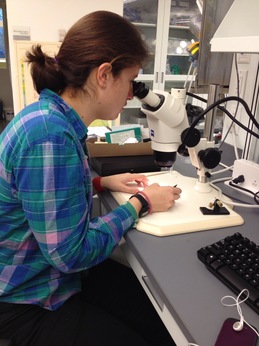
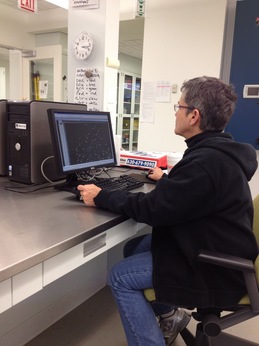
Gia Hallaman, a junior at Northwestern, is helping out with several projects, including counting achenes in x-ray images from Jill’s germination experiment (you can see them on the computer screen below). She is also learning how to identify ants to morphospecies. That means distinguishing different species based on morphology and making our best guess on which species they are. It takes time to develop an eye for the different traits that distinguish closely related species; often the most obvious traits, like color and size, are not informative for differentiating species. Jill is learning to use a combination of tools, including online dichotomous keys and photo databases (antweb.org), to identify ants to species or morphospecies. With her help, we should be able to make a dent in identifying the ants we collected from Minnesota prairie remnants in the summer of 2012.
This January Stuart and Gretel kindly hosted me in Chicago and gave me the opportunity to spend a few weeks working in the Echinacea Project lab continuing my research from the summer. Here is my final paper with some interesting results.
Sanford-Long_EchinaceaHybridization.doc
We are in a quiet period before a marathon of Echinacea germination. Jill Pastick, the intern from Lakeforest College, is preparing an experiment to test different methods of germinating Echinacea achenes. In the past, we have germinated achenes on blue blotter paper placed in petri dishes. While this method has been successful, it has its disadvantages. For example, when seedlings emerge, their roots sometimes attach to the paper, leading to damage when they are removed from the petri dishes. Before we launch into germination for major Echinacea project experiments, Jill will explore the use of agar (a gel produced from algae) as an alternative to paper for germinating Echinacea achenes.
And, for your enjoyment, here is a scene from under the microscope. These ants are part of the collection that Jill Gall led this summer. In case you can’t tell, the one one the right is biting onto the antennae of the one on the left. I believe they are both Formica obscuripes.
|
|