|
|
This file lists flags in random orders suitable for pollinator observation tomorrow.
Here’s the R code used:
flagOrder <- function() {
cat(cat(sample(LETTERS[1:8]),"n"),
    cat(sample(LETTERS[1:8]),"n"),
    cat(sample(LETTERS[1:8]),"n"),
    cat(sample(LETTERS[1:8]),"n"),
    cat(sample(LETTERS[1:8]),"n"),
    "n")
}
for (i in 1:20) flagOrder()
Amanda, Kate, and I have combined our protocols and I’ve included a revised equipment list.
Echinacea PONS equip list.doc
Ech combined PollComp Protocols.doc
The following people have agreed (I think) to help with this project on the mornings of July 7th and July 9th, as well as July 21st and July 23rd. If you cannot for some reason, let us know tomorrow.
Stuart, Gretel, Caroline, Amy, Daniel, Greg, Megan, Mimi, Amanda, Kate. Thanks everyone!
Also, after some discussion with Allegra about her pollination and painting needs for this week, I think that we need to either A) give up one person and therefore one remnant to help Allegra or B) have the normal 4 observations for remnants with less than 8 plants instead of doing more observations within the 3 hr pd, and have those people help Allegra when they are done early with pollinator observations/style collection or C) a combination of A&B. Thoughts?
Note: I have included the protocol in with pollinator observations and style collections because we are using the same plants for all 3. However, 3 people can do this over the course of 3 pm’s. Those who are helping so far are: Kate, Allegra (when not doing pm pollinations)
Friday we practiced catching insects for a half hour but much more practice is needed and those who were not there on friday need to be trained. I think a group training/practicing session before lift-off is imperative.
Today Daniel and Allegra helped me assess the flowering plants situation at some of the remnants we plan on using. We flagged flowering plants at: Riley (5),YOH (3), NRRX (4), LC (8), Steven’s appch (3). Some of these sites had plants that seemed likely to flower by Tuesday so we flagged those plants as well.We randomly selected 8 plants for LC since there were 17 that were either flowering or seemed very likely to flower by Tuesday. There was only 1 plant flowering at NWLF so that site has been eliminated. We also noted co-flowering species for each remnant. Tomorrow we need to finish flagging and randomly selecting plants at the 5 other remnants.
Stay tuned for July 4th picnic and kick-ass sandcastle pictures!
Stuart, here are the estimates of people hours I will need for my project. Also, a schedule of times when I would need helpers during this week. Who wants to trade some hours?
Monday I would ideally like to paint and count styles for up to 80 treatments which I estimate will take 9-10 people hours (depending on how many need to be trained). I would like to do it after phenology or at least do the style persistence before lunch, painting can happen later. Wednesday and Thursday also follow the same schedule.
But… this would mean a big pollination day on Tuesday, when everyone is out in the remnants. Pollination takes about the same amount of time. So Mimi and I have come up with several possible solutions (or a combination):
– If Ruth will be here Tues. morning she could help collecting insects and someone else could help pollinate
– Cut the remnants down to 9 instead of 10
– Have some people in smaller remnants leave a little earlier than 11am, or have vehicles and be able to book it back at 11 to help pollinate from 11-12
– Cut down the treatments painted on Monday, however I don’t want to cut down too much, since some of my plants have been flowering since Thursday or Friday and I don’t want to wait too long
– Skip painting on Monday, paint Tuesday and Thursday, and pollinate Wed. and Friday when we have more people to spare
– I would also like help collecting pollen on Tues. and Wed. but I may be able to do this myself if needed.
– lastly, I need one person to help me do afternoon pollination on Tuesday and Thursday between 2-4pm
Sorry for throwing this into the mix so late in the game folks. I guess it was just hard to know how many hours and people I would need before we did a full day of painting and pollinating.
-Allegra

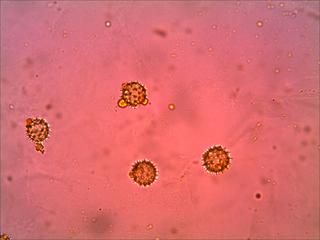
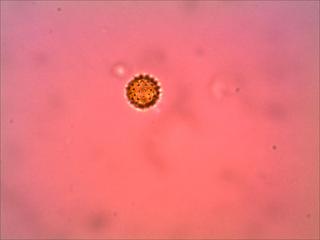
Your choices are: Heliopsis, Coreopsis, and Echinacea. (hint: there is only one species of pollen in each photo.)
Put your guesses in the comments, and we’ll reveal the answers on America’s birthday! Go ahead, put some money on it.
-Daniel and Amanda
EDIT– We will not be announcing the results until there are at least three guesses in the comments!! Get guessin, folks. And happy July 4th!
Today we got the microscope camera in the mail– here are the results!
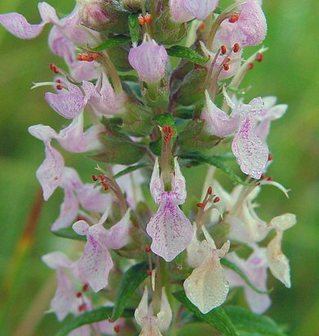
This is the long-awaited photo of Echinacea angustifolia pollen. THIS IS IT, GUYS. Are you crying yet?
Love,
Daniel and Amanda
Over the years I have made several notes about locations of Asclepias viridiflora individuals. I have not noted the species at Staffanson Prairie Preserve. I’ve copied notes below. I can show you where these plants are (on a map or live)…
2-July-1998 site eth
Asclepias vividiflora 6.5 paces S of 2294
1-Aug-1998 site eth
Asclepias viridiflora w pod!
23-July-1998 site nolf
EA pla #3069 cf Asclepias viridiflora 1.1m WSW of this EA
I have mapped an Asclepias viridiflora individual at NRRX. No notes, just the location.
I have collected several seed pods from A. viridiflora at the landfill. Here are the records…
Landfill 9/5/1997 26 seeds 1 pod 4 planted at TP plot
Landfill 9/5/1998 3 pods
Finally, here’s a note from my visor from earlier today. The yellow flags are at your prairie turnip plants.
Note-to-megan
7/3/09 9:31 am
landfill
Asclepias viridiflora
2 fl plas between
yel flags 1-02 & 1-28
1 fl pla between
yel flags 1-31 & 1-52
1 fl pla SSE of
yel flag 1-47 (far S) in dip
It might be fun to see Prairie Home Companion— Free!–in Avon Minnesota.
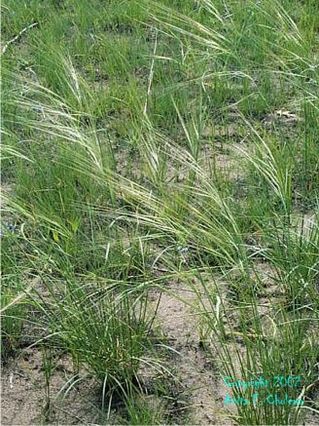
For some time, the powers that be on the Echinacea project have thought, “Wouldn’t it be nice to compare all we’ve learned from coneflower with another important native component of the prairie?” Well, this summer, study of habitat fragmentation and its ecological and evolutionary impacts broadens to include an additional species. And the winner is … Stipa spartea aka porcupine grass! The time is right now to collect the seed, which will be sown into the common garden later this summer.

Here’s a link to a page from the Bell Museum of Natural History about Stipa spartea.
Below, you will find the sampling protocol that Greg and I used to collect seeds from Staffenson Prairie this afternoon. Stuart may have thoughts to add and the strategy might change a bit as we run into the reality of different Stipa remnant populations. In addition to remnants, we will also be collecting seeds from roadside transects. Expect that challenge to be met later next week.
Protocol for sampling Stipa spartea in prairie remnants.doc
|
|