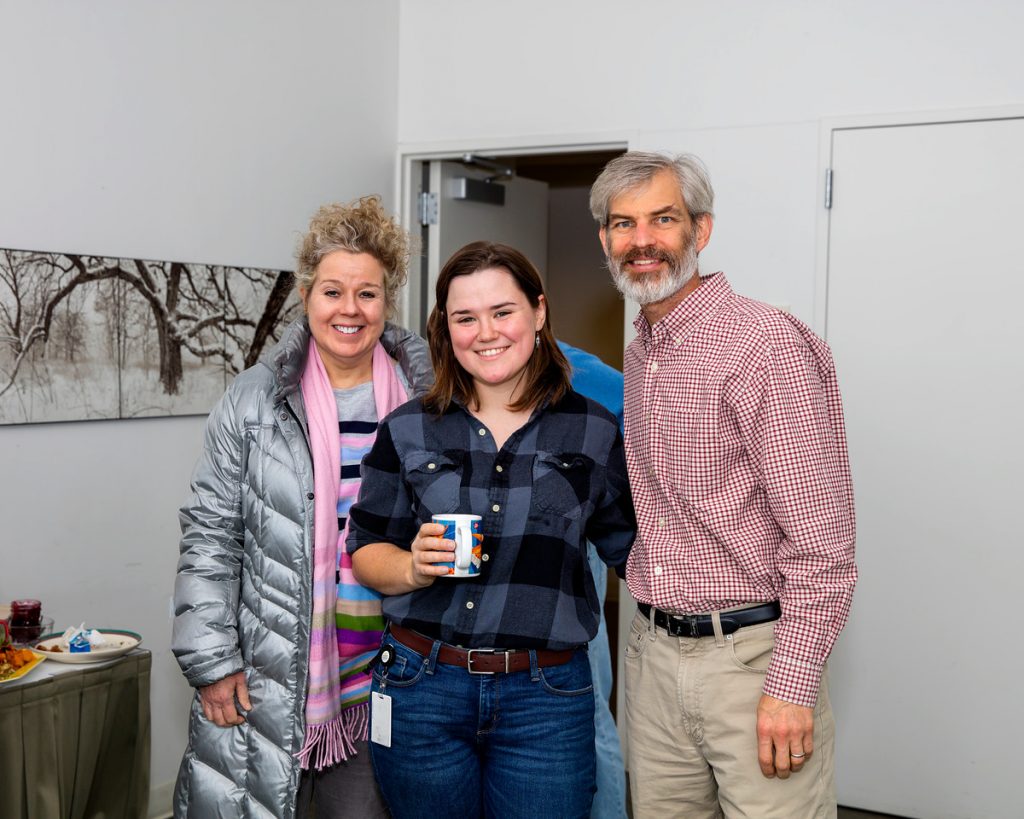
Three weeks have gone by fast! It’s pretty incredible how much we were able to fit into such a short time span.
Our first week was spent getting introduced to the center and the work happening here. We met lots of people as well as lots of lab equipment! We learned how data collection happens for the study of Echinacea, by completing a large set of Echinacea achene counting using new study protocols. This study will hopefully yield interesting insights into how Echinacea plants develop and utilize resources. We also learned how XRays are used and processed (RIP to the XRay machine, gone but not forgot), and spent some time helping organize Echiachea heads for later use.
Our second week, we continued the organization and processing of Echinacea data but also began to develop our own research inquires, based on our own personal interests and the data we had to work with. We all chose very different focuses, mine being a focus on long-term analysis of pollinator diversity and abundance measures, or “How are bee populations changing over time in the Echinacea fields?”
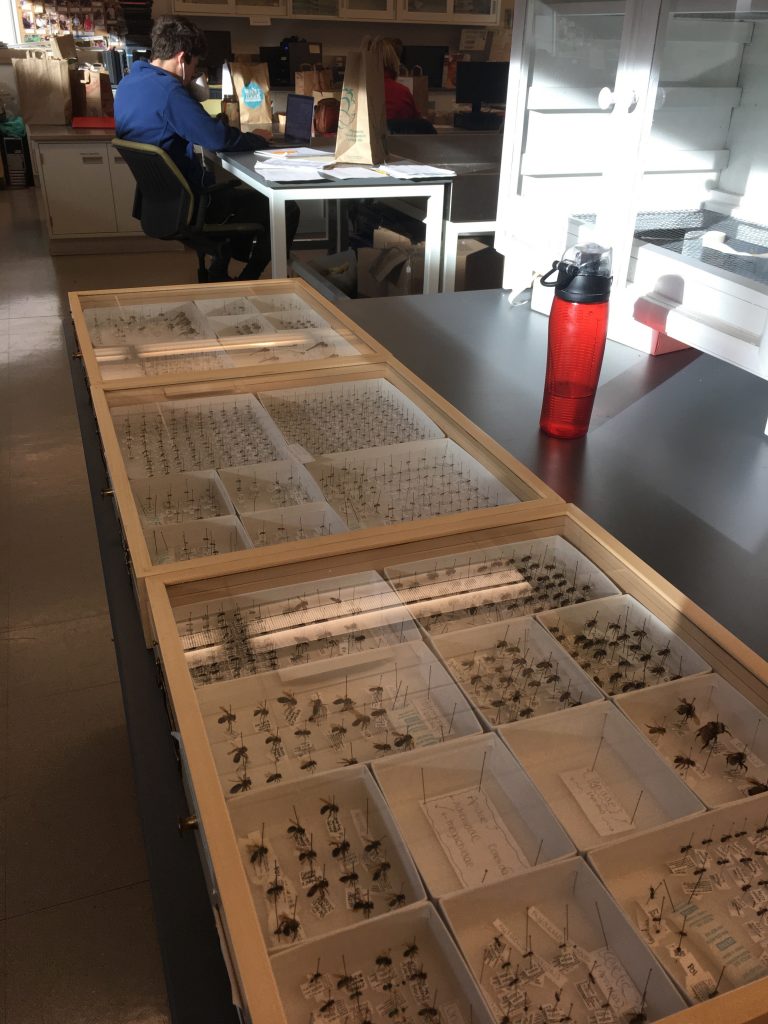
Bee samples that provided me with data for my work
Our third week, we focused in on our projects. Locating and processing my pollinator data took a good deal of time, so I spent a good chunk of the week processing this data as well as learning R, a widely applicable skill for someone interested in science. While I still have a lot of questions and things I’d like to explore further, I am very happy with what I was able to accomplish given the time constraints. Please see my attached presentation below for more detail and major takeaways!
I would like to give a huge thank you to Stuart, Erin, and Riley, who made this entire experience possible. They helped us pretty much every step of the way, whether it was practicing our ‘ABTs’s, scanning seeds, or learning R from the ground up. I am very happy to have had such a productive and fulfilling winter break and look forward to more breaks, and more work like it.
I have very much enjoyed my time here, and after 3 weeks of work am looking forward to the holidays with family, and sleeping in past 6am!
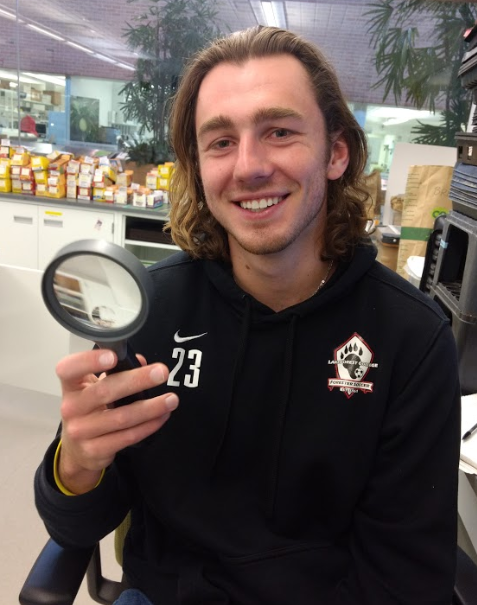
Tate Rosenhagen, an intern from Lake Forest College who spent four week days with the Echinacea Project doing seed research, finished a poster with findings about Echinacea reproductive output and achene weight. We really enjoyed having Tate around, he brought a lot of positive vibes and insightful questions to the lab. Tate is great!
In 2019 100 plants were selected for a flowering induction experiment using liquid smoke at site ALF. They were shot with GPS Darwin. Many of these plants lie beyond boundary fence and are not included in demo/surv. However, records containing a “loc” (numbered 1-100) and the number of heads per plant were taken on visors with the demo form and added to the 2019 demo data. The shot points were not added to surv. The experiment was not executed in 2019.
The demo records were added to aiisummer2019 in file ~aiisummer2019\demo\20190726demo.txt.
Job SMOKE_PLANTS_20190726_DARW contains 100 points shot of plants for the experiment. The job is backed up in three locations:
In 2019 Jennifer Ison tracked and sampled ground nesting bees in Exp. Plot 2 with Miyauna Incarnato, Avery Pearson and Ren Johnson from the College of Wooster. Bees were captured, refrigerated, fluorescent dyed, released and tracked to their nests. Several bee nests were located and shot with GPS Darwin. One was excavated and brought back to Wooster for study.
Job BEENESTS_20190730_DARW contains 13 points shot of nests and their surrounding plants. The job is backed up in three locations:
This summer Shea and John continued our yellow pan trap project to sample the pollinator community found along roads in our study area in Minnesota. Today volunteer Mike Humphrey pinned the last bee from this summer’s collection!
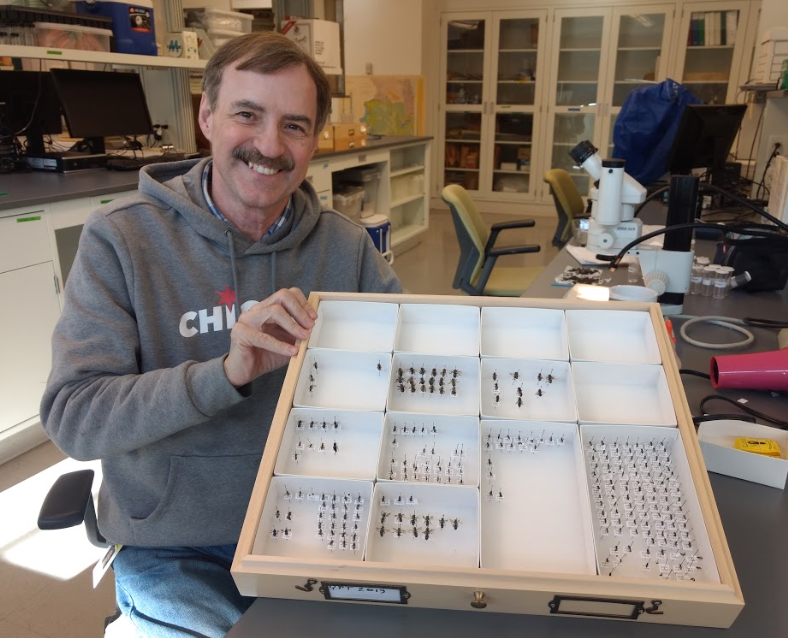
Mike with the collection; next he’ll be consolidating these with Shea’s pinning from this summer to be sent off for ID at the University of Minnesota!
Mike received a surprise on his last day of the year; volunteer Char found a desiccated bee in one of the Echinacea heads she was cleaning! Mike reports it’s different from anything else we have in the collection this year, so a seriously cool find.
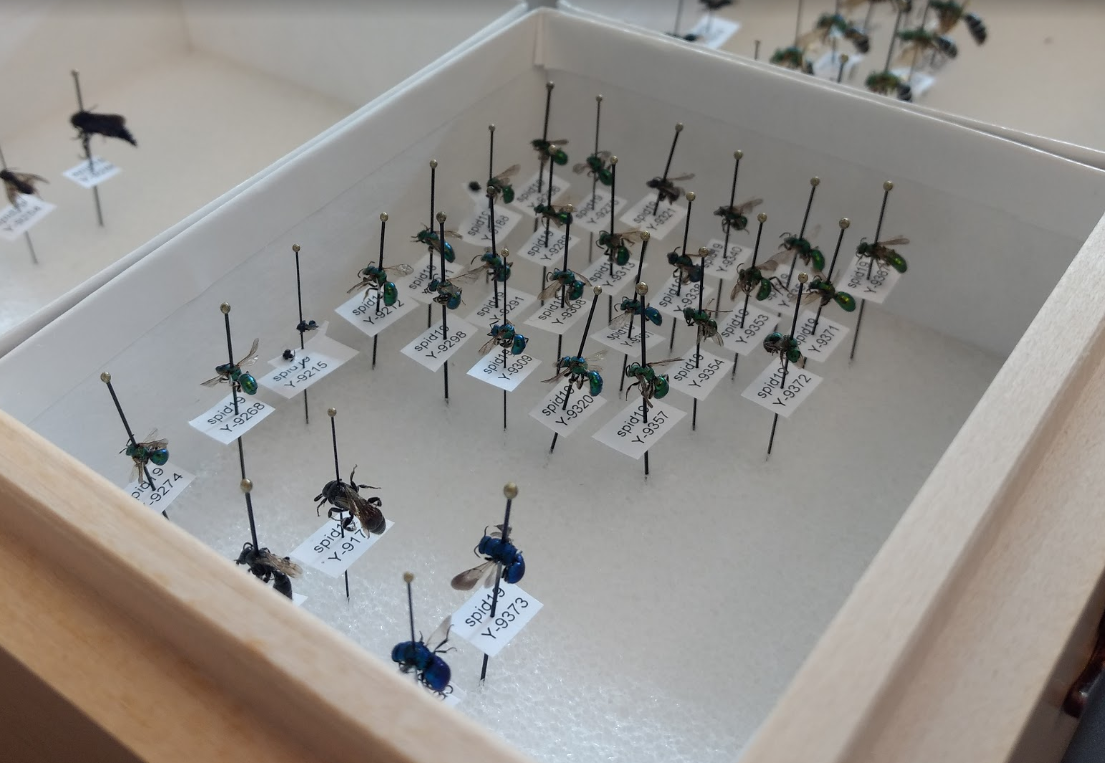
A majority of the bees in our 2019 collection are unremarkable Lasioglossums that we call “small black bees,” but we also get remarkably shiny blue and green bees in our traps!
Thanks for all your hard work Mike, and we’ll see you next year!
Last Thursday, we had our annual Team Echinacea potluck to honor the work of lab volunteers over the past year. Stuart discussed why what we do is so important and how the work of volunteers helps us to answer important scientific questions. Some great recent milestones accomplished by volunteers include:
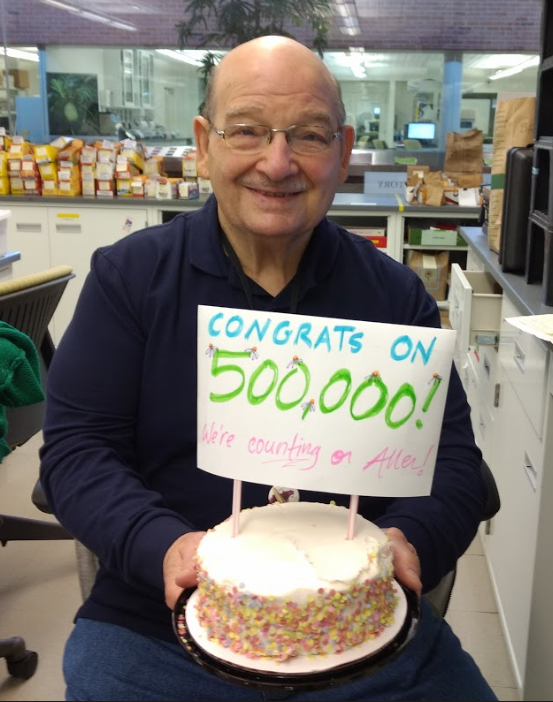
Allen, Sam, and Anne reaching 500,000 achenes counted
All 2017 heads have been cleaned, rechecked, and scanned
670,000 achenes were counted and 113,000 achenes were classified in 2019 (so far)
In addition to a general overview of the Echinacea Project’s goals, members of the lab who have individual projects talked about what they are working on. These projects are: Erin’s remnant flowering intervals, Drake’s prairie parasites, Lea’s floral neighborhood, Elif’s congener ploidy project, and Riley’s prairie fragment crosses. It was really great to talk about research and hear about a number of projects.
Most importantly, though, I want to thank all people who volunteer their time to the lab. Without you, the cutting-edge science we do is impossible. Truly, you are making huge contributions to science and our understanding of plant reproductive fitness in anthropogenically fragmented landscapes. Your work is so appreciated, and we are so lucky to have you all around!
Oh, by the way, the food was absolutely wonderful. 11/10.
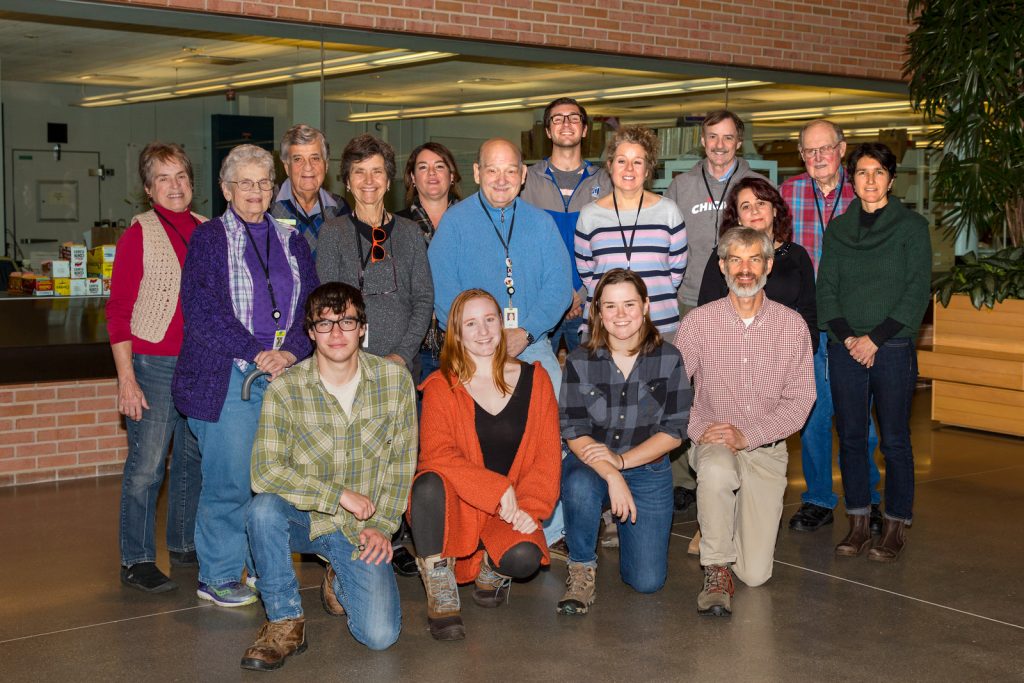
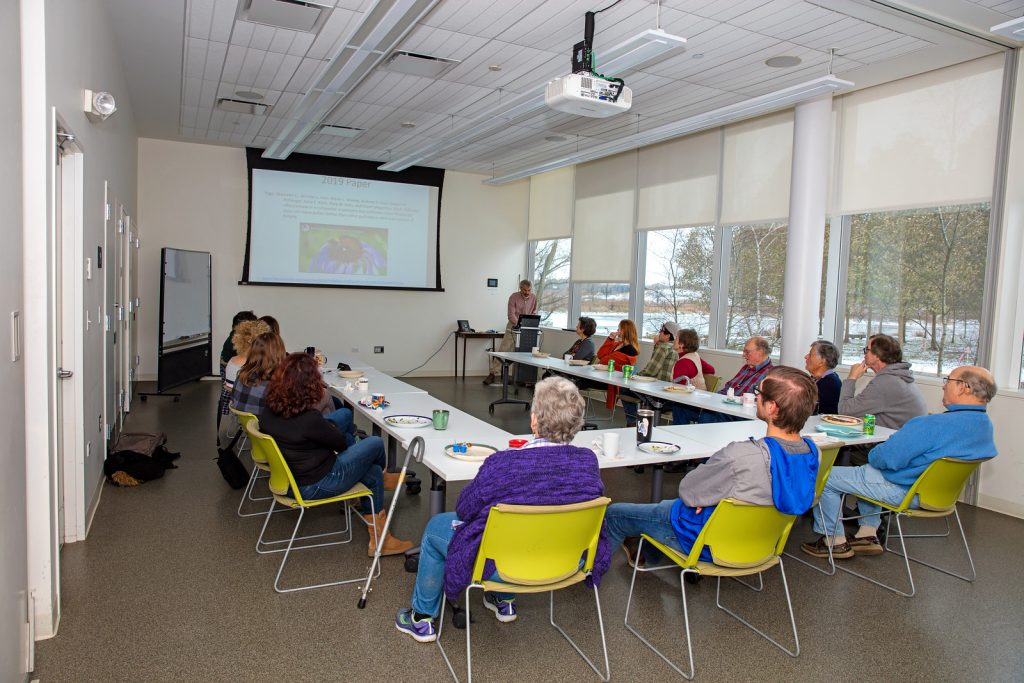
Team Echinacea IL! Front (L to R): Drake, Lea, Erin, Stuart Middle (L to R): Char, Shelley, Allen, Laura, Elif, Gretel Back (L to R): Marty, Art, Tessa, Riley, Mike, AldoFolks eat and Stuart talks about an Echinacea Project paper.Stuart tries to get a good angle on a photo of Riley and Aldo – photoception.Lea, Elif, and Riley. Stuart, Allen, Tessa, and Shelley. Shelley did not see that someone was taking a photo. Laura, Erin, and Stuart.
All of these photos are courtesy of Ray, a volunteer in the photography group. Thank you very much, Ray!!
Tate is interning with us in November with his classmates from Lake Forest College. We’re excited to have his help around lab!
Tate, happy to see a scan with barely any chaff! Nice work, cleaners!
Hi FLOG!
I’m Tate Rosenhagen, a junior biology major at Lake Forest College doing a four week mini internship at the Chicago Botanical Garden for a Plant Biology course. It’s my second week in the Echinacea lab, coming in once a week for four hours, and this week I’m learning how to count achenes and randomize samples! Last week I learned a lot of the background of the Echinacea project; what an achene is, how to remove the achenes from the flower head, and a little bit about Echinacea and their pollinators. One of the questions I hope to answer while I’m here is if there is a relationship between seed number and average seed weight in Echinacea. I hypothesized that in heads with fewer seeds, the average seed weight should be higher as all of the plants are in the same experimental plot and thus are subject to the same conditions and nutrients. If the plants have roughly the same amount of nutrients and conditions, theoretically plants should use the same amount of energy as their neighbors. Therefore, I hypothesized that if one plant has created fewer achenes than another plant, their achenes may have more nutrients in their endosperm thus leading to a higher weight. However, a number of factors could cause plants to use their energy in places other than their seeds, such as damage repair on the plant itself or stem growth. I hope that some of the data I find while I’m here will begin to answer this question, however, only being here once a week for four weeks limits how much data I am able to collect.
Recently, Team Echinacea welcomed a new member, Elif Taskiran. Elif has a PhD in economics, but has recently expressed interest in biological sciences. The Echinacea Project is happy to have her on board! Elif volunteers her time on Fridays, where she engages in data entry and cleans heads. Elif also attends weekly lab meetings, where she engages in paper discussion and gives feedback on various works of the team (like presentations and proposals).
Elif is also very interested in using Chicago Botanic Garden’s flow cytometer to understand ploidy differences between Echinacea angustifolia, E. pallida, E. purpurea, and Echinacea hybrids. We hope this project will be fruitful! Thank you, Elif, for all of your work so far with the Echinacea Project. We look forward to your work in the future!
Last Friday, I was dispatched by Stuart to find the number of plants/ achenes planted in each experimental plot, along with the number alive as of a recent year (2017-2019, based on the plot). Although records of some plots were a bit harder to come across that others, I was able to compile data from each plot (besides p10 – planted 2019 – data coming soon). This would not have been possible without the help of Gretel, so thanks GK! I have attached a small datasheet with the survival data.
In the history of the Echinacea Project, the team has sown 31,888 Echinacea viable achenes in experimental plots. There were many more sown that likely did not have a seed. Team members found 3634 seedlings from these seeds, not including Amy D’s experimental plot 3 and remnant seedling refinds. The team has planted 18,869 Echinacea seedlings in experimental plots, not including p10 – planted at West Central Area HS in 2019. Finally, 7090 Echinacea are currently alive in the experimental plots!